


 English
  中文简体
中文简体 Recently, as safety requirements for global power and communications infrastruct...
Read More
Home · News · Industry News · Stranded vs Solid Wire: Choosing the Right Electrical Conductor for Your Job
Industry News
Stranded vs Solid Wire: Choosing the Right Electrical Conductor for Your Job
2026-08-25Content
Choose a stranded conductor when it will flex, move, or vibrate; choose a solid conductor when it will stay in one place and needs to hold its shape. In most grounding and power installations, both types work well electrically, so the real decision is mechanical. This guide explains what solid and stranded wire are, how they compare, and where each type fits in a practical installation.
What Is Solid Wire?
A solid wire is one continuous length of conductor, normally drawn from copper, copper-clad steel, or aluminum. It has no air gaps along the conductor path and no strands to separate under a screw terminal. Because it is one piece, it keeps the shape you bend it into and gives a clean surface for clamps, lugs, and welding.
The trade-off is stiffness. If you bend it back and forth several times at the same point, it work-hardens and eventually breaks. A small nick on the surface also creates a stress concentration. That is why solid conductor is used mainly in permanently fixed locations: branch circuits in conduit, busbars, terminal strips, and ground rods or ground electrodes.
What Is Stranded Wire?
A stranded conductor is made of several smaller wires twisted or laid together to form one larger conductor. The total copper area determines current capacity; the individual strand size determines flexibility. A conductor with fewer thick strands is easier to handle outdoors; a conductor with many thin strands is better for flexing and vibration.
Many general-purpose overhead and grounding conductors use concentric stranding, often made to IEC 60228 Class 2 or ASTM B8 construction. For more demanding flexing, flexible cords use Class 5 or Class 6 fine stranding. For example, bare hard copper stranded wire is a standard choice for overhead ground wire and fixed horizontal ground loops, while finer stranding is used inside equipment and moving connections.
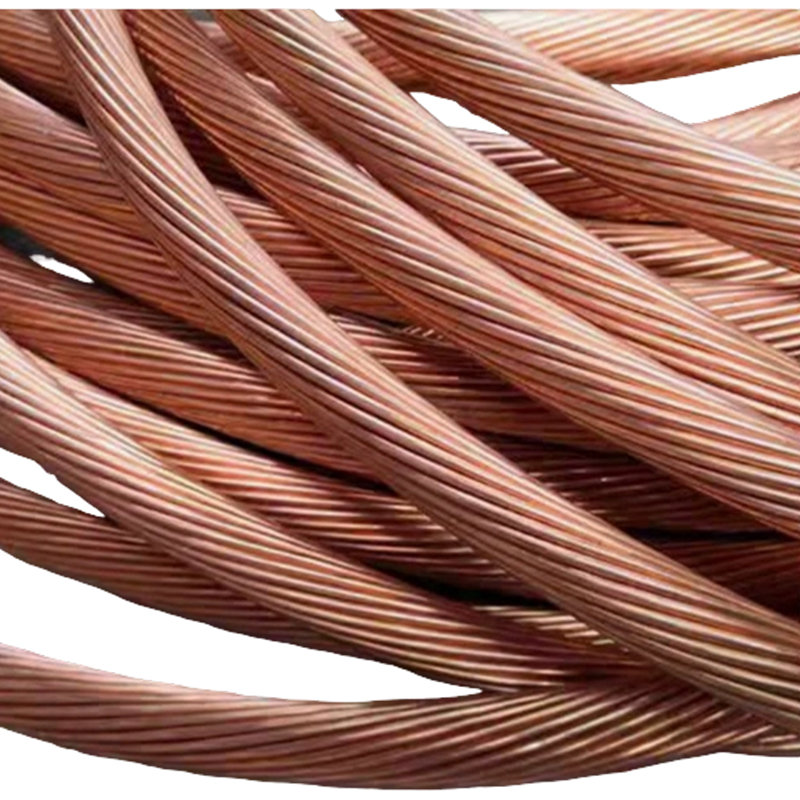 Wholesale Bare Hard Copper Stranded Wire Suppliers, ManufacturersShaoxing Sweld Electric Co., Ltd. is China Bare Hard Copper Stranded Wire manufacturers and Bare Hard Copper Stranded Wire suppliers, we ...View Product →
Solid vs Stranded Wire: Key Differences
Solid and stranded wire differ more in mechanics than in electrical performance. For the same nominal cross-section at power frequency, the current capacity is roughly equal. The practical difference is how the conductor responds to bending, termination, and the environment.
| Property | Solid Wire | Stranded Wire |
|---|---|---|
| Construction | One continuous conductor | Multiple smaller strands twisted together |
| Flexibility | Low; holds formed shape | High; follows tight routing and bends |
| Repeated bending | Can break after work hardening | Better flex life, especially with fine stranding |
| Termination | Stable under screw terminals; no loose strands | Needs ferrules, lugs, or careful twisting; loose strands can short |
| Surface damage | A nick can crack the conductor | A nick in one strand does not break the whole conductor |
| Air gaps and moisture | Fewer gaps | More gaps; can wick moisture unless sealed or tinned |
| Typical applications | Residential branch circuits, busbars, ground rods | Flexible cords, jumpers, control panels, overhead grounding conductors |
| Cost | Lower for a given section | Slightly higher because of stranding process |
Do not overstate the electrical difference. A stranded conductor with many small strands may have a slightly higher DC resistance than a solid conductor of the same nominal area because of air spaces between strands. In practice, this is rarely the deciding factor for a 50/60 Hz power or grounding application. The mechanical behavior determines which conductor will keep working for the full life of the installation.
One purchasing caution: do not compare by outer diameter. A stranded cable often looks thicker than a solid wire with the same copper cross-section because air spaces between strands add to the outer diameter. Confirm the nominal area in AWG or square millimeters rather than relying on visual size.
How to Choose Between Solid and Stranded Wire
Choose solid wire for fixed runs
Use solid wire where the conductor is terminated once and then left alone. Typical examples are building wire inside conduit, busbars, and terminal connections that are not flexed during maintenance. Solid wire is also easier to install in screw terminals because it does not shed loose strands. If a bend is made once and retained, solid wire is faster and usually costs less.
In a grounding system, the same reasoning applies to fixed conductors and earth electrodes. A copper-clad steel round wire is a solid-conductor product that keeps its shape, provides higher tensile strength than pure copper, and resists corrosion in direct-burial applications.
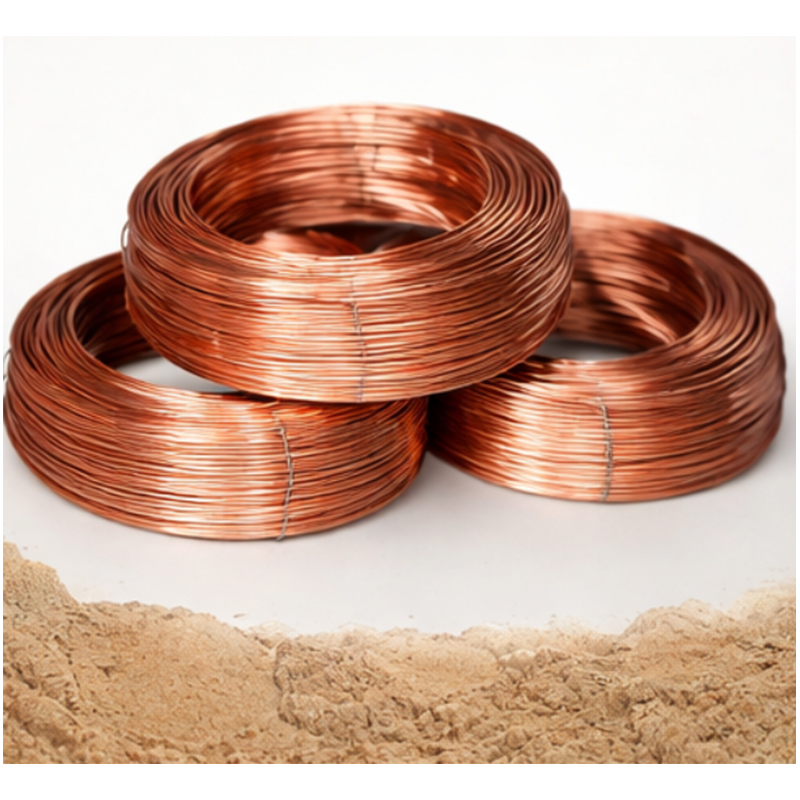 Custom Copper-Clad Steel Round Wire Manufacturers, SuppliersShaoxing Sweld Electric Co., Ltd. is Copper-Clad Steel Round Wire manufacturers and Copper-Clad Steel Round Wire suppliers in China, we c...View Product →
Choose stranded wire for flexibility and vibration
Choose stranded wire when the conductor must move, flex, be pulled around corners, or survive vibration. Typical examples are flexible power cords, pendant wiring, jumpers between equipment, and down conductors that change direction several times. Stranded wire also performs better when a structure expands and contracts, because multiple strands distribute the stress instead of concentrating it in one grain boundary.
If corrosion resistance and flexing both matter, tin-plated flexible copper stranded wire is a reliable option. The tin coating protects the copper surface, and the fine strands keep the cable easy to route. For less demanding fixed outdoor runs, bare hard copper stranded wire is normally sufficient.
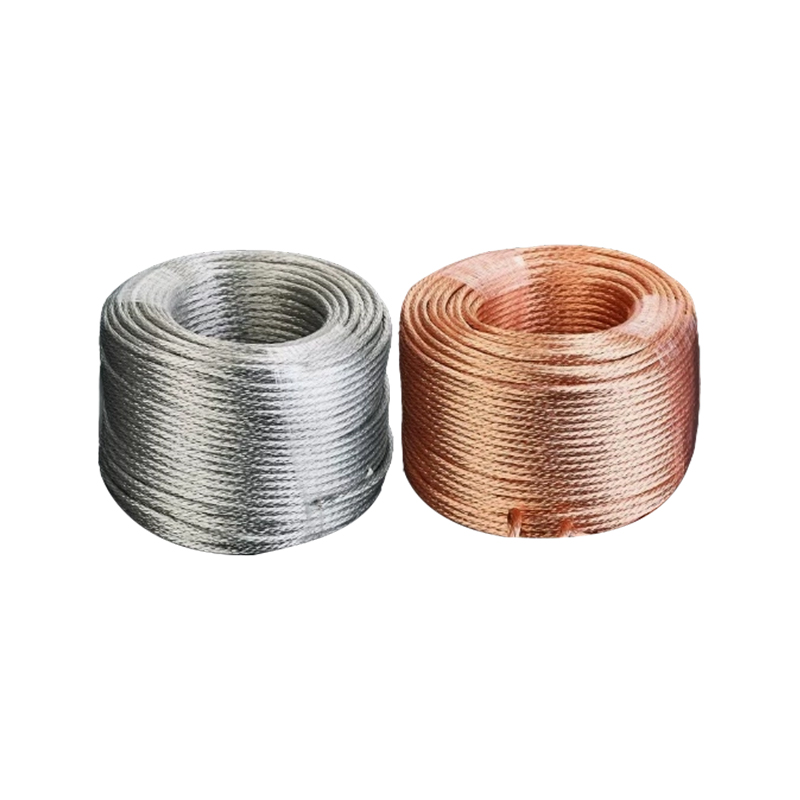 Wholesale Tin-Plated Flexible Copper Stranded Wire Suppliers, ManufacturersShaoxing Sweld Electric Co., Ltd. is China Tin-Plated Flexible Copper Stranded Wire manufacturers and Tin-Plated Flexible Copper Stranded...View Product →
Termination and connection details
Termination is where many stranded installations go wrong. A solid wire stays as one piece under a screw terminal; a stranded wire can shed strands unless you use a ferrule or a properly crimped lug. In damp locations, seal the conductor end or choose a tinned version. For permanent grounding connections, exothermic welding fuses the strands into a solid mass and avoids the loose-strand problem. The best wire type still depends on the quality of the joint, not just the number of strands.
When ordering, compare the same nominal cross-section and stranding class. More strands mean better flex life but also a higher price. Tinned or PVC versions add cost but reduce corrosion and physical damage. For grounding loops, a continuous length is usually better than adding a splice.
Solid and Stranded Conductors in Grounding Systems
Grounding installations use both forms together. A solid rod is driven into the earth; a stranded cable carries fault current from the equipment to the earth electrode; and a solid busbar provides a point where several grounding conductors are joined. In this system, solid and stranded are not competitors. They are selected for different parts of the current path.
For overhead ground wire or horizontal conductors that must follow a trench and bend around obstacles, stranded wire is easier to handle. For vertical earth electrodes and busbars, a solid shape keeps the structure stable. If you are comparing copper-clad steel with other grounding materials, the material decision is separate from the strand count. Our copper-clad steel grounding material selection guide covers that comparison in more detail.
The Practical Bottom Line
The rule is simple. Use solid wire when the conductor will be fixed in place, bent only once, and terminated in a stable way. Use stranded wire when it will be flexed, exposed to vibration, routed through a tight path, or connected to moving equipment. For grounding systems, use both where they fit and make sure every joint is rated for the conductor size and the environment.
Do not make the selection purely on initial price. Stranded wire costs slightly more, but it can save installation time when routing is difficult and it can prevent future breakdowns when vibration is present. Conversely, solid wire can save cost and labor on long fixed runs where stranded flexibility is not needed. When in doubt, choose the conductor that matches the movement of the installation, then confirm the connection method before ordering.
PREV: Copper Stranded Wire: Construction, Finishes, and Grounding Selection Guide
NEXT: Do Lightning Rods Really Work? The Truth About How They Protect Structures
Contact Us
Your email address will not be published. Required field are marked*
Categories
- Company News(1)
- Industry News(19)
News
-
-
Recently, as global requirements for power safety and lightning protection groun...
Read More -
Introduction: More Than Just a "Metal Rod" on the Roof When you look up at the s...
Read More -
Exothermic welding powder plays a crucial role in creating strong and reliable e...
Read More -
Ask any crew that has pulled grounding conductors through a plant retrofit: sol...
Read More -
An electrical grounding system works by creating a dedicated, low-impedance pat...
Read More

The company is committed to in-depth research in the field of
grounding and large-scale manufacturing of products. It is a
comprehensive technology enterprise integrating R&D,
manufacturing and technical services. It is a high-quality
supplier for many domestic first-line engineering construction
companies.
- Contact Information
-
- TEL
- +86-575 8930 2616
- +86-130 6788 7328
- Address
- No. 55, Gaoxiang Road, Shengzhou City, Shaoxing City, Zhejiang Province, China
- Grace Wang
- E-mail: [email protected]
- Phone:+86 135 8735 6239
- WhatApp: +86 135 8735 6239
- WeChat: +86 135 8735 6239
- Lucy Xu
- E-mail: [email protected]
- Phone:+86 139 0585 3744
- WhatApp: +86 139 0585 3744
- WeChat: +86 139 0585 3744
- April Zhang
- E-mail: [email protected]
- Phone:+86 139 0585 4994
- WhatApp: +86 139 0585 4994
- WeChat: +86 139 0585 4994

