


 English
  中文简体
中文简体 An electrical grounding system works by creating a dedicated, low-impedance pat...
Read More

Home · News · Industry News · How Do Thunderstorms Form? The Science of Storm Development and Lightning Safety
Industry News
How Do Thunderstorms Form? The Science of Storm Development and Lightning Safety
2026-09-29Content
Thunderstorms are one of nature's most dramatic weather events. They can appear suddenly on a hot afternoon, turning a clear sky into a dark, rumbling, rain-soaked scene within minutes. But behind the spectacle lies a surprisingly clear sequence of physical processes. Understanding how thunderstorms form is not just a matter of weather curiosity; it also matters for anyone who works with electrical infrastructure, tall structures, or outdoor installations. The same storm that produces lightning is the reason modern grounding and surge protection systems exist.
The Three Ingredients of a Thunderstorm
Every thunderstorm, from a small single-cell pulse to a vast supercell, begins with the same three ingredients:
- Moisture: Water vapor in the air, usually evaporated from oceans, lakes, or wet ground, provides the raw material for clouds, rain, and hail.
- Unstable air: Air that is significantly warmer than its surroundings will continue rising once nudged upward. This condition, called instability, allows air parcels to power through the atmosphere.
- Lift: A mechanism is needed to start the upward motion. This lift can come from a cold front, a warm front, a sea breeze, or air moving up a mountain slope.
| Ingredient | Role | Typical Source |
|---|---|---|
| Moisture | Forms clouds and precipitation | Oceans, lakes, wet soil |
| Unstable air | Allows air to keep rising | Warm, humid surface air |
| Lift | Starts the upward motion | Fronts, sea breezes, mountains |
When all three ingredients combine in the right proportions, the atmosphere becomes a factory for towering cumulus clouds. The stronger the instability and the deeper the moisture, the taller and more energetic the storm becomes. If any ingredient is missing, only fair-weather clouds or light showers may develop.
How a Thunderstorm Develops, Step by Step
Once lift triggers rising air, a thunderstorm typically follows a recognizable life cycle. Meteorologists often divide it into three stages:
- Cumulus stage: Warm, moist air rises in an updraft and cools. Water vapor condenses into visible cloud droplets, releasing latent heat that adds energy to the updraft. The cloud grows vertically into a cumulus cloud.
- Mature stage: The cloud becomes a cumulonimbus, with strong updrafts and downdrafts. Precipitation particles grow heavy enough to fall, dragging air downward. Inside the cloud, ice crystals and supercooled water droplets collide, generating electric charge. This is the stage when lightning, thunder, heavy rain, and sometimes hail occur.
- Dissipating stage: Outflow from the downdraft cuts off the warm, moist inflow, and the updraft weakens. The storm collapses into lighter rain and eventually dissipates.
A single thunderstorm cell may last anywhere from 30 minutes to an hour, but well-organized storms can regenerate as new cells form along the outflow boundary. Regardless of their size, all thunderstorms produce lightning, and that is a detail worth taking seriously.
Why Thunderstorms Produce Lightning
Lightning is the thunderstorm's most dangerous calling card. As the cumulonimbus grows, updrafts carry water droplets high into subfreezing altitudes. There, they become ice crystals and small hail. When these ice particles collide, they exchange electric charge in a process that remains an active area of research. In general, lighter ice crystals become positively charged and drift upward, while heavier graupel becomes negatively charged and stays lower in the cloud. The result is a cloud with positive charge at the top and negative charge near the bottom.
That separation of charge creates a powerful electric field. The negative charge at the cloud base repels electrons on the ground below, leaving the surface with a positive charge. When the field becomes strong enough, a stepped leader, a channel of ionized air, moves downward from the cloud. It meets an upward streamer from a tall, grounded object, and a massive return stroke surges upward. We see this as a flash of lightning. The rapid heating and expansion of air along the channel produces the sound wave we call thunder.
Because the ground's positive charge concentrates on tall structures, trees, and people, the location of a lightning strike is not random. This is why buildings, towers, substations, and industrial facilities need deliberate lightning protection systems, not just a hope that the strike will go elsewhere.
What Thunderstorm Science Means for Lightning Protection
The same physics that creates lightning also shapes the design of protection systems. A lightning protection system gives the electrical charge a controlled path from the point of attachment to the earth. That path usually consists of three parts: an air terminal, a down conductor, and a grounding electrode. When the stepped leader and an upward streamer meet, they connect to the air terminal rather than to a random point on the roof. The current then travels through the conductor and safely dissipates into the soil.
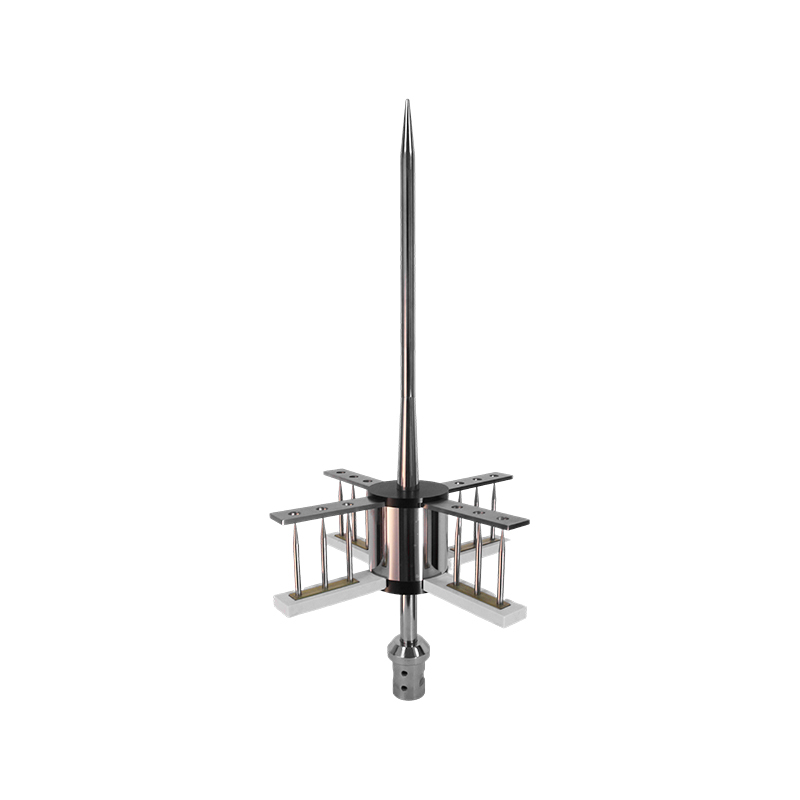 PDC 3.3~6.3 Early Discharge Lightning Rod for Building ProtectionThis non-electronic air terminal activates automatically during lightning, offering selectable protection radii for civil and commercial structures while requiring no maintenance after installation.View Product →
Air terminals come in many forms, from simple rods to early-discharge units designed to create an upward streamer earlier in the strike process. The choice depends on the structure's height, use, and risk profile. But no terminal can do its job without a safe path into the ground.
Grounding Electrodes and Conductors
Once a lightning current reaches the earth electrode system, it must spread harmlessly into the soil. This is where grounding materials matter most. Copper-clad steel rods are a common choice because they combine the conductivity of copper with the mechanical strength of a steel core. They are driven several feet into the ground and connected to the down conductor. For deep or rocky soil, multiple rods and horizontal conductors may be needed to lower the resistance.
 Copper-Clad Steel Grounding Rod for Low-Resistance Earth ElectrodesCombining copper conductivity with steel core strength, this rod is driven deep into soil to spread lightning current safely, especially where resistivity varies with moisture.View Product →
The number and depth of electrodes depend on soil resistivity, which can change with moisture and temperature. A low-resistance grounding system gives lightning current a wide, deep path to enter the earth with less heating and less risk of side-flashing to nearby equipment.
Making Grounding Connections That Last
The connection between the down conductor and the grounding electrode must be reliable and corrosion-resistant. Mechanical clamps can work for temporary or lightly loaded systems, but the industry standard for permanent grounding connections is exothermic welding. The process uses a chemical reaction to fuse two copper or steel surfaces into one solid molecular bond. It does not depend on external power, and it creates a joint that lasts as long as the conductor itself. For more detail on how this process improves electrical connections, see our overview of exothermic welding powder.
 Bagged Exothermic Welding Powder for Permanent Grounding JointsThis high-purity powder creates a molecular bond between conductors via a chemical reaction, ensuring corrosion-resistant, maintenance-free connections for grounding systems.View Product →
A properly welded connection handles repeated surge currents with minimal heating and no loosening over time. It also reduces the risk of corrosion at the joint, which is especially important in the humid conditions that often accompany thunderstorms.
Lightning Protection as a System
Whether you are building a substation, a communication tower, or an industrial facility, the lesson from thunderstorm physics is clear: lightning will find the path of least resistance. The best protection is a low-impedance, well-bonded grounding system designed for the local soil conditions and installed with quality materials. A lightning protection system is not a single product but a combination of air terminals, conductors, connectors, and electrodes that work together.
Understanding how thunderstorms form is the first step toward respecting their power. The same warm, moist air that builds a summer storm can send a current of tens of thousands of amps into your site in less than a second. With carefully selected grounding materials and sound installation practices, that current can be guided into the earth where it belongs.
PREV: How Does Grounding Work? A Practical Guide to Earthing and Fault Current Paths
NEXT: How Does a Lightning Rod Work? A Practical Guide to Complete Protection
Contact Us
Your email address will not be published. Required field are marked*
Categories
- Company News(1)
- Industry News(19)
News
-
-
Yes, lightning rods work — but not in the way many people imagine. They do not ...
Read More -
An air terminal by itself does not protect a building. A lightning rod works on...
Read More -
How does grounding work? Set the jargon aside and it comes down to one simple i...
Read More -
“How does a lightning rod work?” is one of those questions that sounds simple u...
Read More -
Introduction: More Than Just a "Metal Rod" on the Roof When you look up at the s...
Read More

The company is committed to in-depth research in the field of
grounding and large-scale manufacturing of products. It is a
comprehensive technology enterprise integrating R&D,
manufacturing and technical services. It is a high-quality
supplier for many domestic first-line engineering construction
companies.
- Contact Information
-
- TEL
- +86-575 8930 2616
- +86-130 6788 7328
- Address
- No. 55, Gaoxiang Road, Shengzhou City, Shaoxing City, Zhejiang Province, China
- Grace Wang
- E-mail: [email protected]
- Phone:+86 135 8735 6239
- WhatApp: +86 135 8735 6239
- WeChat: +86 135 8735 6239
- Lucy Xu
- E-mail: [email protected]
- Phone:+86 139 0585 3744
- WhatApp: +86 139 0585 3744
- WeChat: +86 139 0585 3744
- April Zhang
- E-mail: [email protected]
- Phone:+86 139 0585 4994
- WhatApp: +86 139 0585 4994
- WeChat: +86 139 0585 4994

