


 English
  中文简体
中文简体 How does grounding work? Set the jargon aside and it comes down to one simple i...
Read More

Home · News · Industry News · How Does a Lightning Rod Work? A Practical Guide to Complete Protection
Industry News
How Does a Lightning Rod Work? A Practical Guide to Complete Protection
2026-09-29Content
“How does a lightning rod work?” is one of those questions that sounds simple until you start explaining it. In their simplest form, lightning rods are metal terminals mounted on the high points of a building. But the useful answer is not just about the rod itself. A lightning rod is really the starting point of a complete lightning protection system. It works by taking an unpredictable, destructive lightning flash and guiding it through a controlled path into the earth, where the energy can safely disperse.
What a Lightning Rod Actually Does
Lightning is a high-voltage, high-current discharge. A typical cloud-to-ground flash can carry tens of thousands of amperes, and the temperature inside the discharge channel can be hotter than the surface of the sun. If that current enters a building through a roof, a wall, a chimney, an antenna, or an electrical system, it can cause fires, explosions, or equipment damage. A lightning rod offers a much better option. The rod intercepts the discharge, a conductor carries it down the structure, and an earthing system spreads it into the soil. That is why engineers often say a lightning rod does not repel lightning; it manages lightning.
| Job | What Happens | Why It Matters |
|---|---|---|
| Interception | The air terminal connects with the upward leader and becomes the strike point. | Keeps the main current away from vulnerable parts of the structure. |
| Conduction | The down conductor carries the current toward the earth. | Controls the path so heat and magnetic forces do not damage the building. |
| Dissipation | The earthing electrodes spread the current into the soil. | Lowers the voltage rise and reduces touch and step potential hazards. |
When a strike happens, the sequence is quick but predictable:
- A downward stepped leader from the cloud moves toward the structure.
- The air terminal produces an upward leader from its tip.
- The two leaders meet, creating a conductive path.
- The main lightning current flows through the rod and down conductor to the earthing system.
- The earthing system spreads the current into the soil.
The Air Terminal: Where the Strike Begins
At the top of the system, the air terminal is usually a solid or hollow metal rod made of copper, stainless steel, or copper-clad steel. It is positioned above the highest point of the structure, where the electric field is strongest. As the cloud builds up charge, an upward leader starts from the tip of the rod and connects with the downward stepped leader from the cloud. Once the two paths meet, the main lightning current flows through the terminal. The air terminal therefore has to be mechanically strong, corrosion resistant, and electrically continuous with the conductor below it.
Modern air terminals can be simple Franklin rods or early streamer emission (ESE) devices. An ESE rod is designed to emit a leader earlier than a conventional rod, which can increase the protected radius in certain designs. The PDC 3.3.6.3 early discharge lightning rod is one example of this type. But no air terminal works alone; it must be tied to a down conductor and an earthing network.
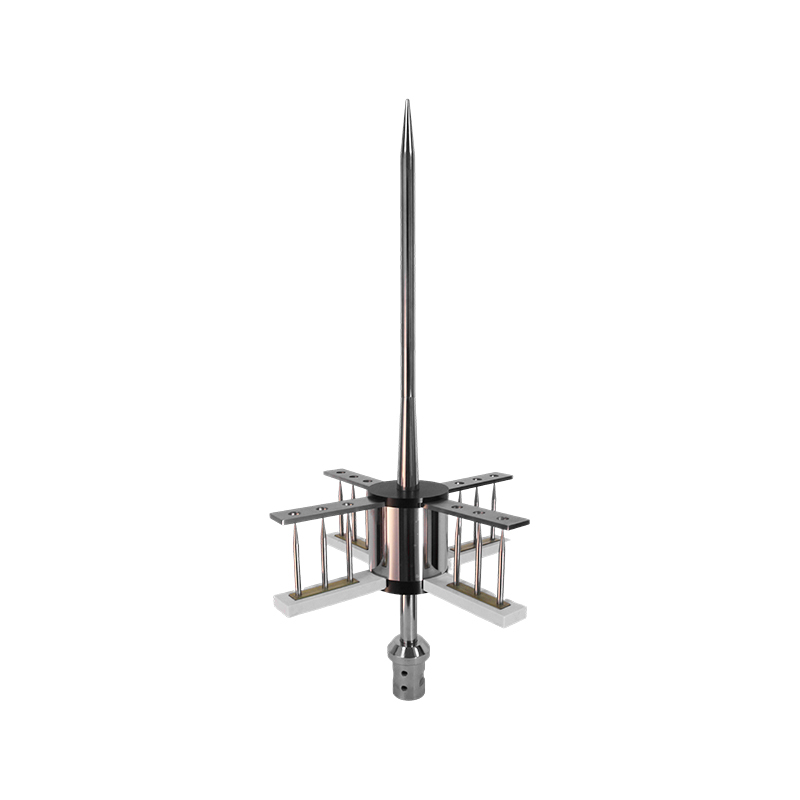 Early Discharge Lightning Rod with Self-Activating Non-Electronic DesignThis ESE air terminal initiates a leader earlier than conventional rods and requires no maintenance. Its attractive design suits civil and commercial buildings while supporting a complete lightning protection system when coupled with proper down conductors.View Product →
The Down Conductor: Carrying the Lightning Current
The down conductor is the link between the air terminal and the earthing system. It is usually a copper or copper-clad cable with enough cross-sectional area to handle the fault current without overheating. The conductor is routed down the outside of the building, away from doors, windows, balconies, and metal objects. Sharp bends are avoided because sudden changes in direction increase inductance and encourage side flashes. If a down conductor must change direction, the curve should be as smooth as possible.
Every connection on the down conductor should be reliable. Mechanical clamps can work, but they may loosen over time or corrode in aggressive environments. For critical joints, exothermic welding is often specified because it creates a permanent molecular bond. The down conductor should also be bonded to other grounded metal systems to reduce potential differences.
When routing a down conductor, keep these rules in mind:
- Avoid sharp bends and vertical loops.
- Secure the conductor firmly to the structure.
- Keep it away from metal windows, doors, and rain pipes.
- Use the same metal family to avoid galvanic corrosion.
The Earthing System: Completing the Circuit
A lightning rod cannot protect a building unless the current has somewhere to go. The earthing system provides that path. It typically includes one or more ground electrodes, such as rods, plates, or a horizontal grid, buried in the soil. The lightning current enters the electrode and spreads outward into the ground, which dissipates the energy and limits the voltage rise at the base of the structure.
Copper-clad steel rods are widely used for this duty because they combine the conductivity and corrosion resistance of copper with the stiffness and economy of steel. The rods are driven deep into the soil so that they remain in contact with moisture and lower-resistivity layers. In sandy, rocky, or very dry ground, more electrodes or longer rods may be necessary. Soil resistivity is the most sensitive factor in earthing design; a system that works well in wet clay may perform poorly in gravel.
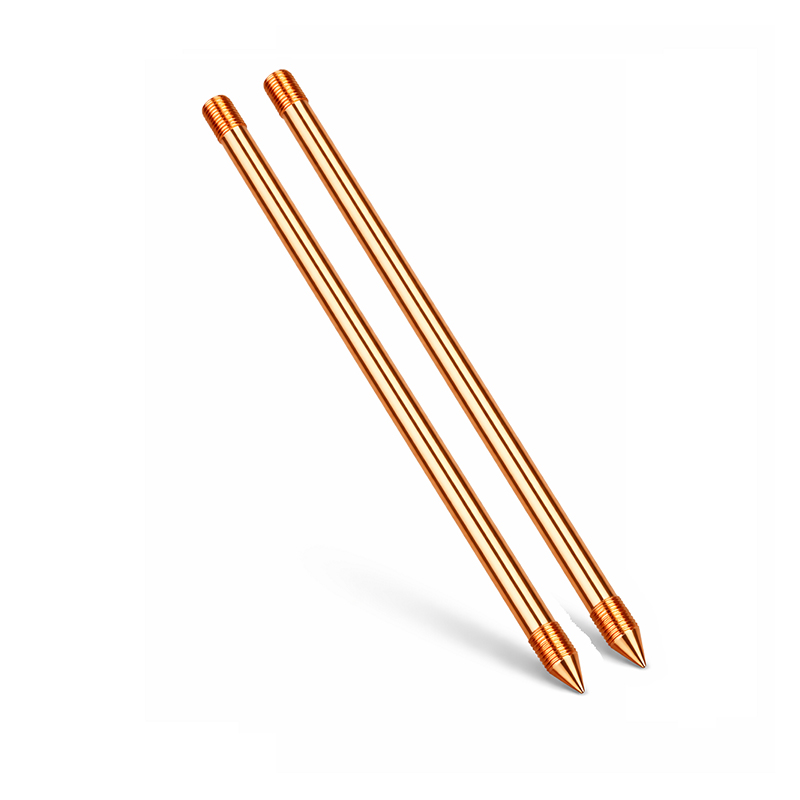 Copper-Clad Steel Ground Rod for Low-Resistance EarthingCombining copper conductivity with steel strength, this rod is driven deep into soil for effective grounding. It addresses variable soil resistivity and is essential for reliable earthing in diverse conditions, complementing exothermic welding connections.View Product →
Why Connections and Joints Matter
The weakest point in any lightning protection system is usually a connection. When a conductor joint is loose, corroded, or undersized, the lightning current can arc across the gap. That arc can start a fire, create surges, and damage nearby equipment. Exothermic welding solves this problem by melting copper conductor ends together with a chemical reaction. The result is a fused joint with lower resistance and higher resilience than a mechanical connection. It does not loosen in service, and it resists most forms of corrosion.
For buried ground rod connections, a mold such as the BW1 ground rod-to-rod welding mold produces a solid joint between two rods. The choice of mold depends on the conductor shape, size, and connection geometry. To understand why the welding material itself matters, read more about how exothermic welding powder enhances electrical connections. When joints are made correctly, the protection system behaves as one continuous conductor from the air terminal to the soil.
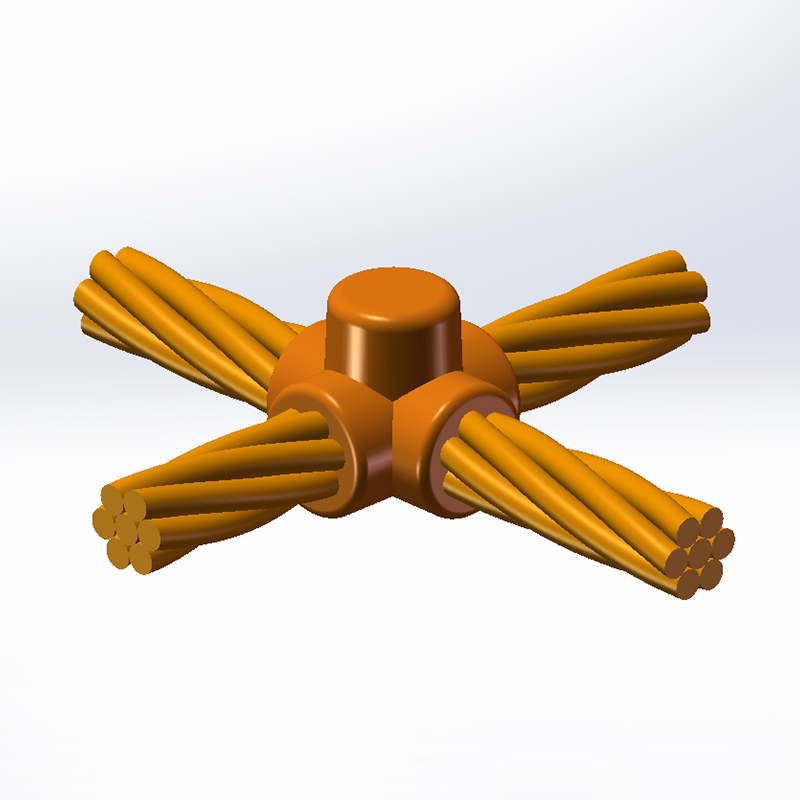 Graphite Welding Mold for Cross Ground Rod ConnectionsThis mold creates a '+' joint between intersecting ground rods, ensuring solid structural and electrical bonds. Engineered for deep grounding networks, it supports grid expansion and maintains continuous conductor integrity from terminal to soil.View Product →
Does a Lightning Rod Attract More Lightning?
This is one of the most common myths. A lightning rod does not act like a magnet pulling lightning from the sky. Tall, isolated, conductive objects already distort the electric field around them, which is why they tend to be struck. The rod simply gives the lightning a well-defined point of attachment once the field becomes strong enough. It changes where the strike goes, not whether a storm will produce a strike in that area. A well-placed rod and earthing system can significantly reduce the damage caused by a direct hit, but it cannot make a building completely immune to every effect of lightning.
Engineers use methods such as the rolling sphere or protection angle to determine the zone of protection around an air terminal. The goal is to cover all vulnerable roof surfaces, chimneys, and rooftop equipment. In practice, multiple air terminals and down conductors may be needed on a large or irregular structure.
Maintenance and Verification
Lightning protection systems are passive, but they still need attention. Joints should be inspected after major storms, and the grounding resistance should be measured from time to time. If the resistance rises above the design target, additional electrodes may be needed. Air terminals can be damaged by corrosion, by wind, or by roof maintenance work. A conductor that has been removed or disconnected is no longer a protection system. Regular inspection is the best way to confirm that every part of the chain is still intact.
A lightning rod works because it gives lightning the safest possible route. The air terminal intercepts the flash, the down conductor carries it, and the earthing system disperses it into the ground. These three functions have to work together. When the rod is well positioned, the connections are sound, and the grounding resistance is low, the system can protect a building for decades. If you are planning a new installation, our guide to lightning rods explains the broader design approach and how to choose the right air terminal for your structure.
PREV: How Do Thunderstorms Form? The Science of Storm Development and Lightning Safety
NEXT: How Does Electrical Ground Work? A Practical Guide to Grounding Systems
Contact Us
Your email address will not be published. Required field are marked*
Categories
- Company News(1)
- Industry News(19)
News
-
-
Every building, substation and telecom tower quietly depends on metal buried in...
Read More -
An air terminal by itself does not protect a building. A lightning rod works on...
Read More -
Yes, lightning rods work — but not in the way many people imagine. They do not ...
Read More -
Introduction: More Than Just a "Metal Rod" on the Roof When you look up at the s...
Read More -
Thunderstorms are one of nature's most dramatic weather events. They can appear...
Read More

The company is committed to in-depth research in the field of
grounding and large-scale manufacturing of products. It is a
comprehensive technology enterprise integrating R&D,
manufacturing and technical services. It is a high-quality
supplier for many domestic first-line engineering construction
companies.
- Contact Information
-
- TEL
- +86-575 8930 2616
- +86-130 6788 7328
- Address
- No. 55, Gaoxiang Road, Shengzhou City, Shaoxing City, Zhejiang Province, China
- Grace Wang
- E-mail: [email protected]
- Phone:+86 135 8735 6239
- WhatApp: +86 135 8735 6239
- WeChat: +86 135 8735 6239
- Lucy Xu
- E-mail: [email protected]
- Phone:+86 139 0585 3744
- WhatApp: +86 139 0585 3744
- WeChat: +86 139 0585 3744
- April Zhang
- E-mail: [email protected]
- Phone:+86 139 0585 4994
- WhatApp: +86 139 0585 4994
- WeChat: +86 139 0585 4994

