


 English
 中文简体
“How does a lightning rod work?” is one of those questions that sounds simple u...
Read More

Home · News · Industry News · How to Protect a Building from Lightning: A Practical Guide to Complete Protection
Industry News
How to Protect a Building from Lightning: A Practical Guide to Complete Protection
2026-10-22Content
- 1 The Anatomy of a Lightning Protection System
- 2 Air Terminals: Catching the Strike at the Highest Point
- 3 Down Conductors: A Direct Path from Roof to Ground
- 4 The Earthing System: Releasing the Energy into the Ground
- 5 The Hidden Weak Point: Connections Between Conductors
- 6 Bonding, Surge Protection, and Routine Checks
Lightning arrives without warning, yet its effects are rarely random. A single strike can carry hundreds of millions of volts into a building, starting fires, destroying electronics, and endangering everyone inside. The honest engineering answer to how to protect a building from lightning is not to rely on a single rooftop device, but to build a complete system that catches the strike, conducts its energy down, and disperses it safely into the earth. In this guide we will walk through each stage of that process, from the air terminal on the roof to the buried electrodes below, and explain the practical decisions that make a lightning protection system genuinely work.
The Anatomy of a Lightning Protection System
A lightning protection system follows a simple principle: give the discharge an intentional, well-designed path to the ground so it never has to find its own way through the building fabric. Every complete system combines four working parts:
- Air termination network — rods or conductors on the roof that intercept the strike before it reaches the structure.
- Down conductors — vertical routes that carry the current from the roof to the earthing network.
- Earthing system — buried rods and conductors that dissipate the charge into the surrounding soil.
- Equipotential bonding and surge protection — measures that prevent dangerous voltage differences inside and around the building.
Each part depends on the others. A tall, impressive air terminal means nothing if the conductor below it is undersized, the earthing resistance is too high, or the joints have already corroded. Treating the system as a whole is the first habit of good lightning protection.
Air Terminals: Catching the Strike at the Highest Point
The air terminal, usually called the lightning rod, is the most visible element of the whole installation. Its job is to be the first point of attachment for the lightning channel, giving the strike a controlled contact point that protects the roof and the structure underneath it.
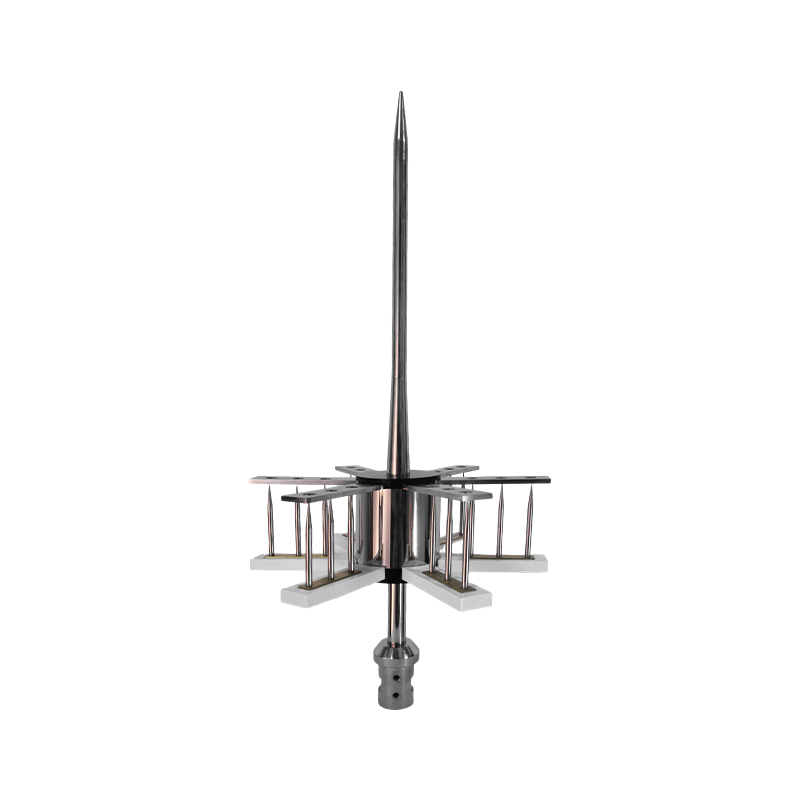 PDC Early Discharge Lightning Rod SeriesThis non-electronic ESE air terminal activates before a strike, extending protection radius with low maintenance and long service life. Suited for diverse building types.View Product →
Two families of air terminals are common today. Conventional Franklin rods are simple vertical conductors that create a protected zone above and around the building. Early streamer emission (ESE) rods go a step further: they are designed to emit an upward leader earlier than an ordinary rod, which extends their effective protective radius and gives designers more freedom on complex roof layouts. Units such as the PDC and SI series fall into this category, and both types are available in pure copper for strong corrosion resistance.
Whatever terminal you choose, coverage is what matters most. The terminal height, position, and the number of terminals must be calculated so that every part of the roof lies inside the protected zone. On large or irregular buildings, several terminals interconnected by air-termination conductors are almost always necessary.
Down Conductors: A Direct Path from Roof to Ground
Once the air terminal has taken the strike, the current needs a fast, direct route to the earth. Down conductors are solid copper conductors fixed to the outside of the building, connecting the roof network to the earthing system.
Three installation rules deserve special attention. First, keep the route as short and straight as possible; every bend adds inductance and increases the chance of side flashes. Second, avoid tight corners — a conductor should curve gently with a large radius, never turn sharply. Third, maintain separation between down conductors and internal wiring, water pipes, or any other metallic path inside the building, so that the lightning current does not jump sideways into the structure.
Large or tall buildings normally need multiple down conductors placed around the perimeter. Spreading the current between several parallel paths reduces heating and magnetic stress at any single point, which is why standards such as IEC 62305 recommend a minimum number based on the building dimensions.
The Earthing System: Releasing the Energy into the Ground
If the air terminal is the face of the system, the earthing network is its foundation. It is hidden underground and easy to neglect, yet it is the part that actually disperses the lightning current. Without a good earthing system, even the most impressive rooftop installation cannot protect a building from lightning in a meaningful way.
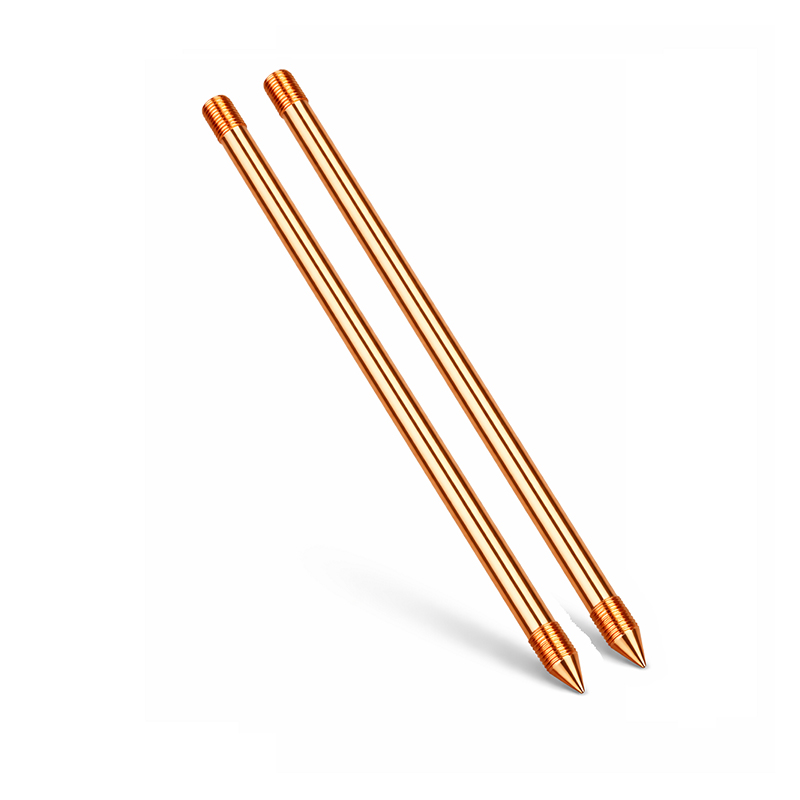 Copper-Clad Steel Ground RodA durable grounding rod that combines steel strength with copper conductivity, ensuring reliable charge dispersion in the earthing network.View Product →
Ground rods are the classic building block of an earthing system. Driven vertically into the soil, they provide the contact surface that lets the charge spread into the earth. The material of those rods makes a real difference in performance and service life, as the table below shows.
| Property | Pure Copper Rod | Copper-Clad Steel Rod | Hot-Dip Galvanized Steel Rod |
|---|---|---|---|
| Corrosion resistance | Excellent | Very good | Moderate |
| Mechanical strength | Moderate | High | High |
| Cost level | High | Balanced | Economical |
| Best applications | Severe chemical environments | General building and tower grounding | Cost-sensitive rural projects |
Soil conditions influence the grounding result more than the rod alone. In high-resistivity soil, a single rod may not be enough; installing several rods in parallel, using longer rods, or adding horizontal conductors are all proven remedies. For a closer comparison, our grounding material selection guide explains the practical differences in more detail.
The Hidden Weak Point: Connections Between Conductors
Between the roof terminals, the down conductors, and the buried electrodes, a lightning protection system contains many junctions. Each junction is a potential failure point, and in our experience, poor connections cause more failed protection systems than any other single issue.
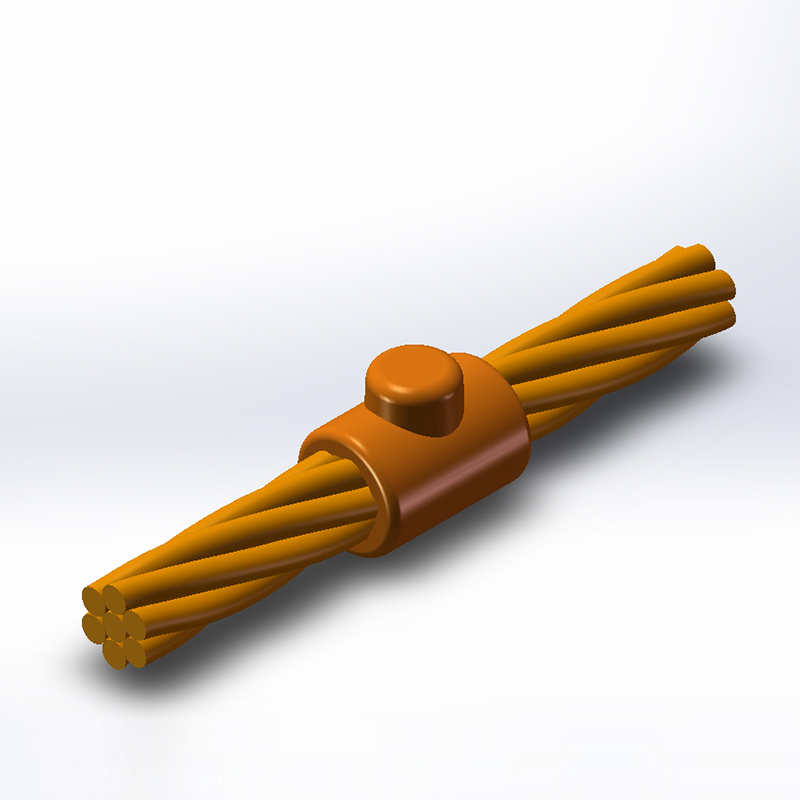 Cable-to-Cable Exothermic Welding MoldA graphite mold that creates permanent, low-resistance joints between cables, eliminating connection failures caused by thermal cycling and corrosion.View Product →
Mechanical clamps and bolts are convenient, but they are also prone to loosening under thermal cycling and to corroding in damp soil. Over time, a bolted joint develops resistance, and under the extreme current of a lightning strike, high resistance means local heating, sparks, and sometimes outright failure.
Exothermic welding solves that problem. The process uses a graphite mold and a specially formulated welding powder to fuse two conductors into a single continuous mass of metal. The finished joint has no separable interface, no added resistance, and no exposed surface that can corrode. Benefits worth remembering:
- The welded joint carries repeated fault currents without degrading.
- It outperforms clamps in corrosion resistance, especially underground.
- It does not require periodic re-tightening or maintenance.
- It provides the same current-carrying capacity as the conductor itself.
For anyone asking how to protect a building from lightning properly, exothermic welding is the difference between a system that looks complete and one that genuinely performs when it matters.
Bonding, Surge Protection, and Routine Checks
An external system that catches and conducts lightning is only half of the protection story. Two additional measures complete the picture, and both are easy to underestimate.
Equipotential bonding connects the building's major metal parts — steel frames, metal roofs, pipes, cable trays, and equipment housings — to the same earth reference. This prevents dangerous voltage differences between separate metal objects during a strike, eliminating the side flashes and sparking that injure people and start fires indoors.
Surge protection devices (SPDs) address the second threat. Even a strike several hundred meters away can induce powerful surges on power and data lines. SPDs installed at the main service panel and at critical equipment terminals clamp those surges before they reach sensitive electronics.
Finally, no protection system should be installed and forgotten. Inspect the visible parts annually, check that every connection is tight and free of corrosion, and measure earth resistance periodically. After a confirmed or suspected strike, repeat those checks immediately, since even a well-built system can be damaged by a direct hit.
Protecting a building from lightning is not about installing a single rod and hoping for the best. It is about designing a complete path — interception, conduction, dispersion, bonding, and surge protection — and then choosing components that will still be sound decades later. When every connection is welded, every material is matched to the environment, and every part of the path is properly sized, a structure can face a storm with confidence.
If you are planning a new lightning protection installation or upgrading an existing one, the team at Sweld Electric is happy to help with component selection and technical advice. We supply air terminals, down conductors, earthing electrodes, and exothermic welding products to projects around the world, and we welcome questions of any size. Feel free to contact us with your layout and requirements, and we will do our best to support you.
PREV: How to Protect Your Solar Power System From Lightning: A Practical Grounding Guide
NEXT: How Does Grounding Work? A Practical Guide to Earthing and Fault Current Paths
Contact Us
Your email address will not be published. Required field are marked*
Categories
- Company News(1)
- Industry News(29)
News
-
-
Every solar power system faces a real electrical threat from lightning. Whether...
Read More -
Every building, substation and telecom tower quietly depends on metal buried in...
Read More -
Lightning storms are not a separate kind of weather system; they are thundersto...
Read More -
Electrical contractors rarely arrive on site with a single task. On a grounding...
Read More -
How does grounding work? Set the jargon aside and it comes down to one simple i...
Read More

The company is committed to in-depth research in the field of
grounding and large-scale manufacturing of products. It is a
comprehensive technology enterprise integrating R&D,
manufacturing and technical services. It is a high-quality
supplier for many domestic first-line engineering construction
companies.
- Contact Information
-
- TEL
- +86-575 8930 2616
- +86-130 6788 7328
- Address
- No. 55, Gaoxiang Road, Shengzhou City, Shaoxing City, Zhejiang Province, China
- Grace Wang
- E-mail: [email protected]
- Phone:+86 135 8735 6239
- WhatApp: +86 135 8735 6239
- WeChat: +86 135 8735 6239
- Lucy Xu
- E-mail: [email protected]
- Phone:+86 139 0585 3744
- WhatApp: +86 139 0585 3744
- WeChat: +86 139 0585 3744
- April Zhang
- E-mail: [email protected]
- Phone:+86 139 0585 4994
- WhatApp: +86 139 0585 4994
- WeChat: +86 139 0585 4994

