


 English
 中文简体
Every building, substation and telecom tower quietly depends on metal buried in...
Read More

Home · News · Industry News · How to Protect Your Solar Power System From Lightning: A Practical Grounding Guide
Industry News
How to Protect Your Solar Power System From Lightning: A Practical Grounding Guide
2026-10-22Content
Every solar power system faces a real electrical threat from lightning. Whether the array sits on a sloped roof or across an open field, its panels, cables, inverter, and monitoring devices make up a long conductive network that can carry destructive energy from a storm. In our years of supplying grounding components to solar contractors and system integrators, we have seen the same pattern again and again: the inverter fails, the DC string stops producing, or a nearby strike damages panels that should have survived.
Why Solar Power Systems Are Vulnerable to Lightning
Solar arrays are oriented to capture sunlight, which usually means open rooftops, wide fields, and other exposed positions. That exposure also makes them a convenient channel for electrical discharge. The modules themselves are not engineered as lightning rods, but the metal frames, mounting rails, and DC cables become unintended conductors when a storm builds up opposite charges overhead. In a ground-mounted installation, the long wiring runs form loops that can pick up a strong electromagnetic pulse from a nearby strike. A rooftop system, meanwhile, is separated from the earth only by the building structure, so an uncoordinated grounding path can send surge current through the inverter rather than safely into the soil.
How Lightning Damages Solar Equipment
Damage usually appears in one of three ways, and each requires a different countermeasure.
| Threat | How It Enters | Typical Damage |
|---|---|---|
| Direct strike | Lightning connects directly to a panel, rack, or cable | Melted metal, broken glass, failed bypass diodes |
| Induced transient | Electromagnetic coupling into long DC or AC cables | Destroyed inverter input circuits, tripped breakers |
| Ground potential rise | Lightning current raises local earth voltage | Arcing between metal parts, fire risk, sensor damage |
When we inspect damaged systems, the panels themselves often survive even when lightning strikes nearby. The failure usually happens at the weakest point in the protection chain: poor ground resistance, a loose clamp, or a missing surge protective device.
A Practical Four-Step Protection Plan
Lightning protection for solar equipment is a coordinated system, not a standalone accessory. Every countermeasure reinforces the others. Here is the sequence we use when evaluating a site.
Step 1: Install an Air Terminal Above the Array
The first decision is whether to add a lightning rod or mast. The air terminal’s job is simple: capture a direct strike at a controlled point and give the current a low-resistance path into the ground. A well-placed rod can be more effective than a maze of surge suppressors. Modern early streamer emission terminals expand the catch area for industrial sites, while a conventional copper rod remains reliable for small rooftops. If you are deciding which design fits your roof geometry, it helps to understand how lightning rods work so you can avoid common placement errors.
Step 2: Build a Low-Resistance Ground Electrode System
The grounding electrode is where the current finally disappears. For a solar array, the earth electrode should be as close as possible to the inverter and the down conductor, and the total resistance to ground should be as low as the local electrical code requires. In poor soil, a single rod is often not enough. Multiple ground rods spaced at least twice their length can lower resistance, and copper-clad steel rods withstand corrosion better than plain copper in harsh soil. We recommend starting with two or more deep copper-clad steel electrodes instead of over-relying on the utility ground.
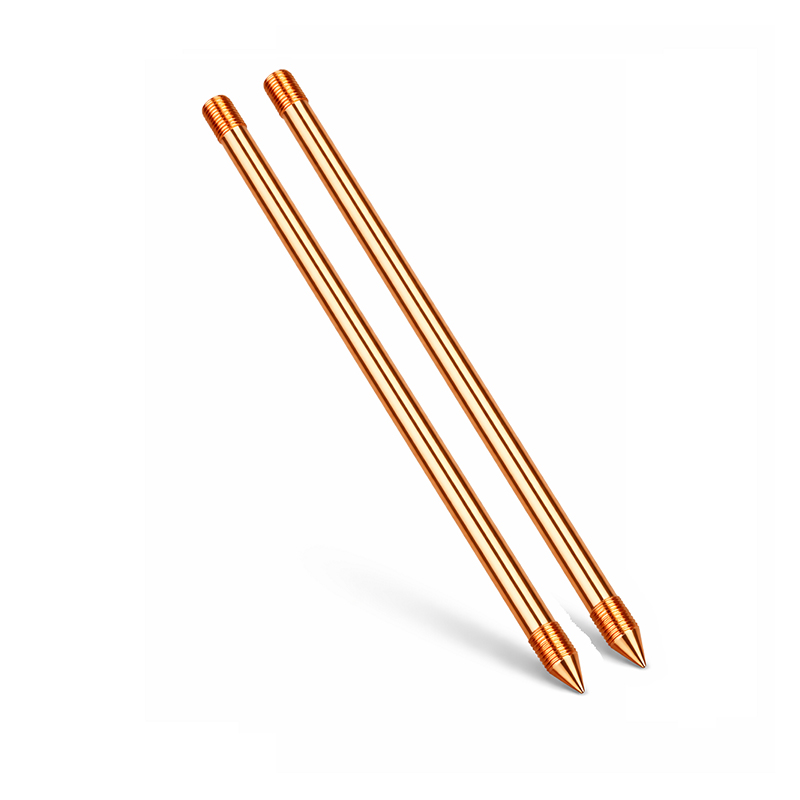 Copper-Clad Steel Grounding Rod for Solar ArraysThis grounding rod offers corrosion resistance and low-resistance earth connection, recommended when multiple electrodes are needed for effective solar system grounding.View Product →
Step 3: Bond Every Metal Surface
Equipotential bonding prevents voltage flashover between different metal parts. In a solar plant, that means connecting module frames, mounting rails, combiner boxes, inverter housings, and cable trays to the same grounding conductor. If one part is grounded and the next is not, lightning can arc from the first to the second and travel through sensitive electronics. Bonding is especially important on rooftop systems, where building reinforcement steel may already carry a partial lightning current.
Step 4: Install Surge Protective Devices at the Right Locations
Surge protective devices, or SPDs, keep fast overvoltages from reaching sensitive components. Place Type 2 or Type 3 devices on both the DC side and the AC side of the inverter, close to the equipment, with short conductors that keep the let-through voltage low. An SPD is not an alternative to grounding; it works only when the earthing system is solid. Many inverter failures are caused by SPDs installed on a ground wire with too much impedance, so inspect the total path before relying on the protective device.
Grounding Connections That Actually Last
Grounding quality also depends on how pieces are joined. A mechanical clamp can loosen from thermal cycling or corrode at a rate that depends on soil moisture. In a lightning event, a poor joint becomes a source of arcing and high impedance. Exothermic welding creates a permanent molecular bond between conductors, so the connection stays stable at the same resistance as the wire itself. This matters at joints between the down conductor and the ground rod, between cable and busbar, and between multiple electrodes in a ground ring. We have seen old exothermic-welded joints survive years underground while clamped connections nearby had to be replaced twice. For a solar grounding system, the same rule applies as for substations and tower grounding: weld the connections that you cannot afford to inspect.
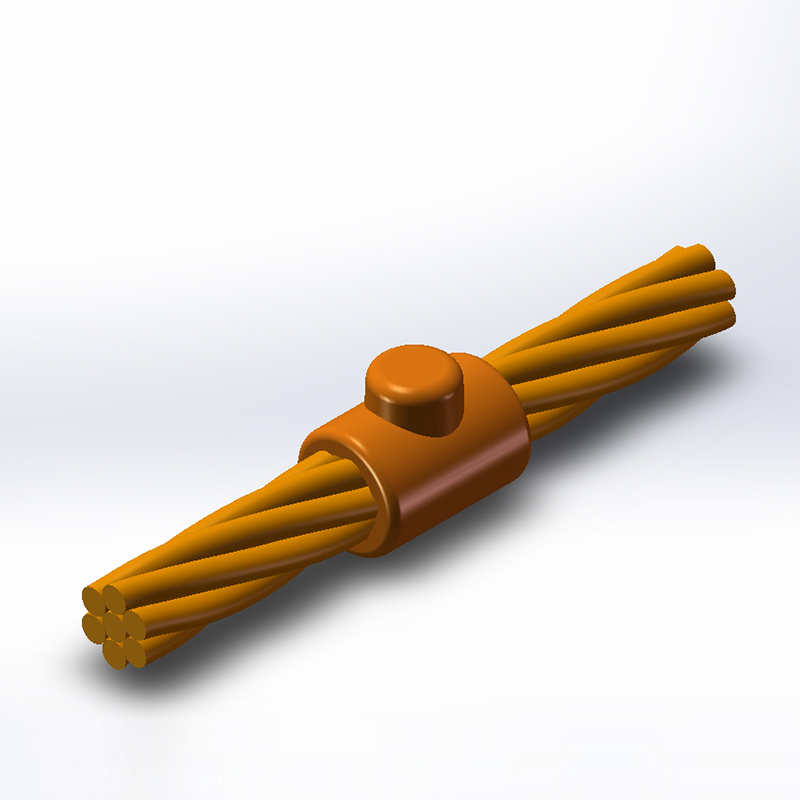 Standard Cable-to-Cable Exothermic Welding MoldThis graphite mold creates permanent molecular bonds for grounding connections, ensuring stable low resistance where mechanical clamps can loosen or corrode over time.View Product →
Practical Checklist for Your Solar Grounding System
- Position the air terminal at the highest point and keep the down conductor as straight and short as possible.
- Use at least two ground electrodes if the soil is rocky or the local resistance target is difficult to reach.
- Join the down conductor to the ground electrode with an exothermic weld rather than a clamp.
- Bond module frames and racking to the grounding conductor with flexible jumpers or solid copper straps.
- Install DC and AC surge protective devices as close as possible to the inverter, using short leads.
- Measure the grounding resistance after installation and again before each storm season.
- Keep a record of resistance values so future tests show whether the ground system is degrading.
Protecting a solar power system from lightning always comes back to the same fundamentals: a clean capture point, a low-resistance path to the soil, and surge suppression that sees an honest ground reference. When those fundamentals are right, a severe storm becomes a routine event rather than a repair project. If you are planning an installation or upgrading an older system, common material and selection questions are answered on our FAQ page, and we are glad to help you choose the right grounding rods, welding molds, and connection accessories.
PREV: How Is Lightning Formed? The Complete Science Behind a Lightning Strike
NEXT: How to Protect a Building from Lightning: A Practical Guide to Complete Protection
Contact Us
Your email address will not be published. Required field are marked*
Categories
- Company News(1)
- Industry News(29)
News
-
-
Lightning arrives without warning, yet its effects are rarely random. A single ...
Read More -
“How does a lightning rod work?” is one of those questions that sounds simple u...
Read More -
How does grounding work? Set the jargon aside and it comes down to one simple i...
Read More -
Lightning storms are not a separate kind of weather system; they are thundersto...
Read More -
Introduction: More Than Just a "Metal Rod" on the Roof When you look up at the s...
Read More

The company is committed to in-depth research in the field of
grounding and large-scale manufacturing of products. It is a
comprehensive technology enterprise integrating R&D,
manufacturing and technical services. It is a high-quality
supplier for many domestic first-line engineering construction
companies.
- Contact Information
-
- TEL
- +86-575 8930 2616
- +86-130 6788 7328
- Address
- No. 55, Gaoxiang Road, Shengzhou City, Shaoxing City, Zhejiang Province, China
- Grace Wang
- E-mail: [email protected]
- Phone:+86 135 8735 6239
- WhatApp: +86 135 8735 6239
- WeChat: +86 135 8735 6239
- Lucy Xu
- E-mail: [email protected]
- Phone:+86 139 0585 3744
- WhatApp: +86 139 0585 3744
- WeChat: +86 139 0585 3744
- April Zhang
- E-mail: [email protected]
- Phone:+86 139 0585 4994
- WhatApp: +86 139 0585 4994
- WeChat: +86 139 0585 4994

