


 English
 中文简体
Lightning storms are not a separate kind of weather system; they are thundersto...
Read More

Home · News · Industry News · How Are Lightning Bolts Formed? Step-by-Step Science of Storm Electricity
Industry News
How Are Lightning Bolts Formed? Step-by-Step Science of Storm Electricity
2026-11-20Content
- 1 How Charge Separation Builds a Storm Battery
- 2 From Electric Field to Stepped Leader
- 3 The Return Stroke: When the Bolt Becomes Visible
- 4 Why a Lightning Bolt Looks Jagged and Branches
- 5 From Formation to Protection: Where the Current Goes
- 6 Safety Lessons Hidden in the Formation Process
- 7 Practical Takeaways for Engineers and Installers
Every lightning bolt is the visible end of a chain reaction that begins well before a flash appears. Inside a thundercloud, tiny ice crystals and soft hail collide, electrons shift between them, and the cloud becomes a charged battery. When the electric field grows strong enough, air breaks down, a channel of plasma forms, and a bolt can leap between cloud and ground. The process is fast, but it has clear stages.
How Charge Separation Builds a Storm Battery
Thunderstorms are charge-separation engines. Strong updrafts carry supercooled water above the freezing level, where ice crystals and graupel—soft, frosted ice pellets—grow and collide. During those collisions, small amounts of charge transfer between particles. Lighter ice crystals tend to gain positive charge and are carried upward, while heavier graupel tends to carry negative charge and settles toward the cloud base. The result is a charge separation: a negative region near the base and a positive region higher up.
Real storms are messier. They often contain several charge centres, and wind shear can tilt them. The basic principle still holds: moving particles separate charge, and the cloud stores electrical energy. The growing charge difference creates an electric field. Air is normally a good insulator, so nothing visible happens until the field approaches breakdown. That threshold is high, but a thundercloud is not clean air. Hydrometeors, cosmic rays, and natural free electrons can help start the process. A few free electrons accelerate, collide with nitrogen and oxygen molecules, knock more electrons loose, and begin an avalanche.
From Electric Field to Stepped Leader
The avalanche is the beginning of a conductive channel. In a cloud-to-ground flash, the channel usually starts near the cloud base and propagates downward in a series of short, branching steps. This is the stepped leader. It moves too faintly for most human eyes to see, especially in daylight, and it pauses between steps while new sections of air break down ahead of it.
Each branch is a path of ionized air; the leader does not choose a target in any conscious sense. It simply follows the easiest available path through a region of mixed conductivity. As the stepped leader approaches the ground, the electric field near tall objects, towers, trees, masts, and even people in open ground becomes very intense. Small upward filaments called streamers can rise from those points to meet the descending leader. When one of those streamers connects with a branch of the leader, the conductive path between cloud and ground is complete. At that instant, the stage is set for the bright part of the bolt.
The Return Stroke: When the Bolt Becomes Visible
Once the channel connects, a large current pulse travels along it. This is the return stroke, and it usually moves upward from the attachment point, not downward from the cloud. The current heats the narrow channel to roughly 30,000°C in a fraction of a second. Air becomes a glowing plasma, expands explosively, and produces the shock wave we hear as thunder. The visible flash and the thunder are two expressions of the same energy release.
The return stroke also explains flicker: a single flash may contain several pulses that reuse the same channel, separated by tens of milliseconds. Peak currents vary widely. Many strokes carry tens of kiloamperes; the strongest can exceed 100 kA. For protection, the peak current, charge transferred, rise time, and number of pulses all matter.
| Stage | What happens | Why it matters |
|---|---|---|
| Charge separation | Ice crystals and graupel collide, and positive and negative charge collect in different parts of the cloud. | Builds the electric field that makes air breakdown possible. |
| Stepped leader | A faint, branching channel of ionized air steps downward from the cloud base. | Creates the conductive path toward ground. |
| Upward streamer | Tall or grounded objects send small filaments upward to meet the leader. | Helps determine where attachment occurs. |
| Attachment and return stroke | Leader and streamer connect; current surges along the channel and the air glows brightly. | Produces the visible bolt and most of the thunder. |
| Subsequent strokes | Additional current pulses may reuse the same channel. | Explains flickering and multiple flashes. |
Why a Lightning Bolt Looks Jagged and Branches
The leader's branches explain the familiar jagged shape. A bolt is not a single clean line drawn through the sky; it is a network of ionized paths, one of which wins the connection to ground. Other branches may fade or end in midair. The return stroke tends to follow the completed channel, so the brightest part of the image traces the successful route. The zigzag appearance comes from the stepwise growth of the leader and from variations in air conductivity, humidity, and particle content along the path.
Not Every Flash Reaches the Ground
Intracloud flashes travel between charge regions inside one cloud, cloud-to-cloud flashes bridge separate clouds, and positive ground flashes can start from the upper, positively charged part of a storm. Positive flashes are less common but can be especially energetic relative to the storm they come from; they are one reason why protection design should not assume that every strike behaves like the typical negative flash.
From Formation to Protection: Where the Current Goes
Lightning protection cannot stop a thundercloud from separating charge. It can give the current a controlled path when a bolt forms. A practical system usually works in layers: an air terminal or lightning rod creates a preferred attachment point; a down conductor carries current toward earth; a grounding electrode contacts the soil; and bonding connects metal parts so they rise and fall in voltage together rather than arc. To see how a rod fits into this chain, read our guide to how a lightning rod works. The terminal is only one part; the path below it matters just as much.
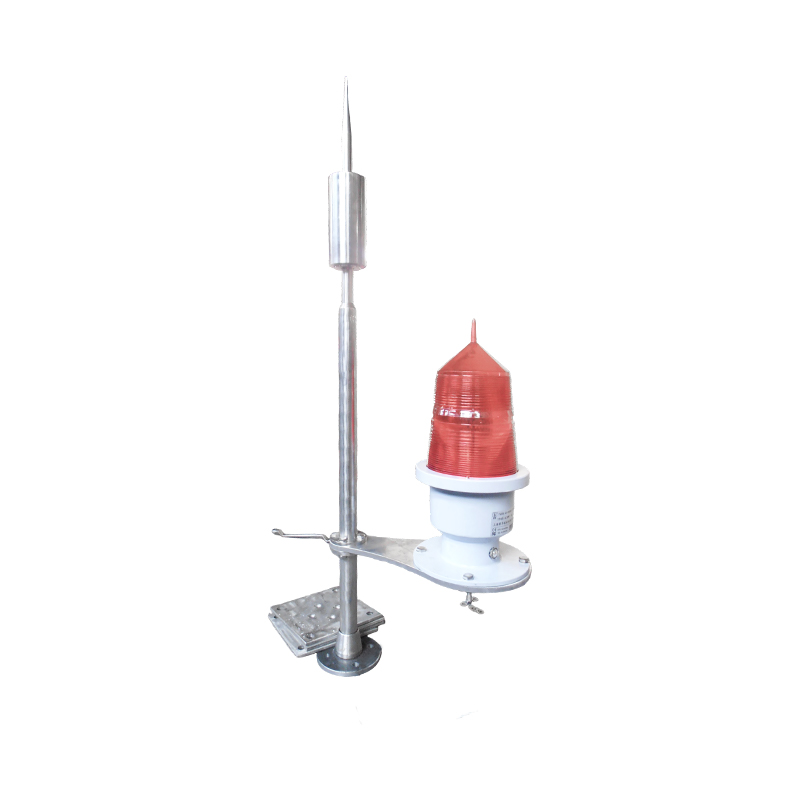 SI Advance Early Discharge Lightning RodWorth reviewing as the air-terminal element in a layered protection path; controlled tip pulses shorten upward-leader initiation, with protection radii by level.View Product →
Grounding electrodes come in several forms. Copper-bonded steel rods combine a steel core for strength with a copper surface for conductivity and corrosion resistance. Performance depends on soil resistivity, rod length, spacing, and connections. A rod driven into dry, rocky soil may need to be longer, grouped with other rods, or supplemented with a grounding enhancement material. The goal is not simply a rod in the ground, but a low-impedance path that stays stable over time.
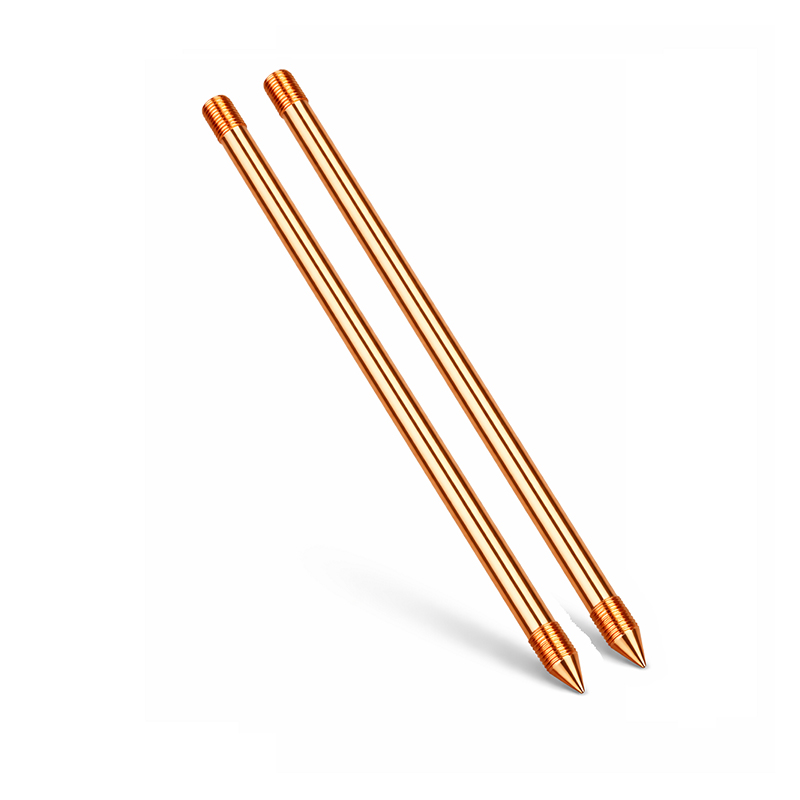 Custom Copper-Clad Steel Grounding RodsSteel-core rods with a copper layer pair strength with conductivity for grounding paths, and available diameter, length, and joint options support site matching.View Product →
Connections are often the weak point. A clamp can loosen, a bolted joint can corrode, and a thin contact area can heat under a surge. Exothermic welding creates a permanent, molecular bond between conductors. A controlled reaction between a copper oxide mixture and aluminum produces molten copper that flows into a graphite mold and fuses the conductors. Because the weld has no mechanical fasteners to loosen, it is widely used for grounding conductors, ground rods, and cable-to-busbar joints. The powder and mold must match the conductor type and size, and the operator needs a clean, dry surface and the right tools. We supply exothermic welding powders, molds, mold clamps, and toolkits for these connections.
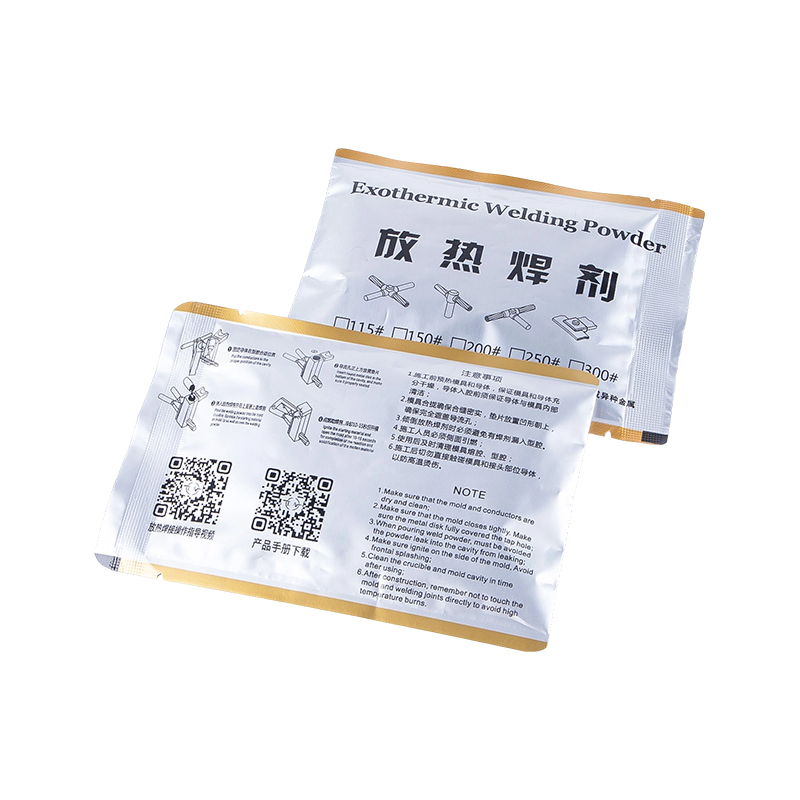 Exothermic Welding Powder for Grounding ConnectionsA high-temperature reaction forms permanent, conductive bonds without external power; copper-content grades and single-weld or bulk formats suit different joint sizes.View Product →
Material choice is also a corrosion decision. Copper, brass, copper-bonded steel, and hot-dip galvanized steel behave differently in soil, especially where chlorides, sulfates, or stray current are present. A design that ignores corrosion can lose its low impedance after a few seasons. The conductor, electrode, and connection method should be considered as one system.
Safety Lessons Hidden in the Formation Process
Lightning safety messages often begin with a simple rule: if you can hear thunder, you are close enough to be struck. That is because the formation process can produce bolts outside the visible rain core, and positive flashes can strike some distance from the main storm. The stepped leader is invisible, so there is no reliable warning sign in the sky before attachment. People in open fields, on rooftops, near isolated trees, or holding metal equipment are especially exposed. The safest action is to move into a substantial building or a hard-topped vehicle and stay there until at least 30 minutes after the last thunder. This is not a matter of being overly cautious. A bolt forms through a path that can branch, and the branch that reaches ground is not always the one a casual observer would predict.
Practical Takeaways for Engineers and Installers
For engineers and installers, the formation process suggests a few practical checks:
- Confirm air terminal placement and the protected zone rather than treating a rod as a decorative point.
- Verify the down conductor path and bonding at every metal transition.
- Match grounding electrodes and connectors to soil conditions and expected fault current.
- Inspect welded and clamped connections after installation, and keep records for maintenance.
No single component makes a lightning protection system. The system works because each part—air terminal, conductor, electrode, and connection—supports the others. If you are selecting materials for a project, our FAQ covers common grounding and connection questions, and our team can help match products to your drawings.
PREV: No previous article
NEXT: How Are Lightning Storms Formed? A Clear Guide to the Science and Safety
Contact Us
Your email address will not be published. Required field are marked*
Categories
- Company News(1)
- Industry News(29)
News
-
-
Thunderstorms are one of nature's most dramatic weather events. They can appear...
Read More -
Lightning is one of the few natural events you can watch from start to finish a...
Read More -
Lightning is one of nature's most spectacular and destructive displays. Over th...
Read More -
Lightning arrives without warning, yet its effects are rarely random. A single ...
Read More -
Electrical contractors rarely arrive on site with a single task. On a grounding...
Read More

The company is committed to in-depth research in the field of
grounding and large-scale manufacturing of products. It is a
comprehensive technology enterprise integrating R&D,
manufacturing and technical services. It is a high-quality
supplier for many domestic first-line engineering construction
companies.
- Contact Information
-
- TEL
- +86-575 8930 2616
- +86-130 6788 7328
- Address
- No. 55, Gaoxiang Road, Shengzhou City, Shaoxing City, Zhejiang Province, China
- Grace Wang
- E-mail: [email protected]
- Phone:+86 135 8735 6239
- WhatApp: +86 135 8735 6239
- WeChat: +86 135 8735 6239
- Lucy Xu
- E-mail: [email protected]
- Phone:+86 139 0585 3744
- WhatApp: +86 139 0585 3744
- WeChat: +86 139 0585 3744
- April Zhang
- E-mail: [email protected]
- Phone:+86 139 0585 4994
- WhatApp: +86 139 0585 4994
- WeChat: +86 139 0585 4994

