


 English
 中文简体
Lightning is one of the most powerful and visible forces in nature. Every secon...
Read More

Home · News · Industry News · How Lightning Forms: Charge Separation, Stepped Leaders and Return Strokes
Industry News
How Lightning Forms: Charge Separation, Stepped Leaders and Return Strokes
2026-11-14Content
- 1 The Charge Build-Up Inside a Thundercloud
- 2 How the Strike Begins: Stepped Leaders and Upward Streamers
- 3 The Return Stroke: Where the Light and the Thunder Come From
- 4 The Full Sequence of a Cloud-to-Ground Flash
- 5 Not Every Flash Reaches the Ground
- 6 What This Means for Lightning Protection
- 7 The Half of the System Nobody Photographs
Lightning is one of the few natural events you can watch from start to finish and still find hard to believe. The sky darkens, the air turns heavy, and then a bright branch connects cloud and ground faster than the eye can follow. Behind that flash sits a chain of physical steps that researchers have been assembling for more than two centuries, and the picture is still being refined. Below is the working explanation we use every day in our own trade, written for the people who design, install and maintain lightning protection and grounding systems.
The Charge Build-Up Inside a Thundercloud
A cumulonimbus cloud is essentially a large charge generator. Warm, moist air rises quickly, cools as it climbs, and turns into a tower of supercooled droplets, ice crystals and soft hail. Strong updraughts keep these particles suspended and constantly colliding, and every collision is a small opportunity to move electric charge from one particle to another.
Ice collisions do most of the work
The important region sits roughly between minus 10 and minus 40 degrees Celsius, where ice crystals and heavier graupel share the same space. Laboratory work and balloon soundings suggest that the lighter ice crystals tend to leave the collisions carrying positive charge, while the heavier, rimed particles take on negative charge. Updraughts lift the light crystals toward the cloud top; gravity keeps the graupel nearer the base. The result is a layered structure: a large positive region high up, a broad negative region below it, and often a smaller pocket of positive charge close to the cloud base.
The field has to be broken before anything visible happens
In calm weather the electric field near the ground is only around a hundred volts per metre. Inside an active storm cell it can reach several hundred thousand volts per metre, three or four orders of magnitude higher. Dry air breaks down at roughly three million volts per metre at sea level, so the cloud alone does not always close the gap. Raindrops, hail and ice particles distort the local field around themselves, and free electrons created by cosmic rays help seed ionisation. When the enhancement is enough, the air stops behaving like an insulator and a discharge begins.
How the Strike Begins: Stepped Leaders and Upward Streamers
The first visible stage of a cloud-to-ground flash is the stepped leader, a channel of ionised air that leaves the cloud base carrying negative charge. It does not descend smoothly. Instead it advances in short segments of roughly fifty metres, pauses for a few millionths of a second, then steps again, typically branching as it goes. The whole descent takes a few tens of milliseconds, and the leader is faint compared with what follows.
As the leader nears the ground, something remarkable happens on the surface. The field at the tip of any tall or pointed object, a rod, a tree, a mast, even a person standing in the open, becomes intense enough to launch its own upward streamer of ionised air. When one of those streamers meets the descending leader, the path is joined and the attachment point is fixed. Whichever object wins that race is the one that takes the current.
This is why a properly designed air termination is not a magnet that pulls lightning out of the sky. It is a controlled, predictable starting point for the upward streamer and a robust route for the current that follows. Anyone curious about the finer details will find a useful explanation in our note on how lightning rods actually work.
The Return Stroke: Where the Light and the Thunder Come From
Once the two channels meet, the charge stored along the leader path discharges into the ground in a matter of microseconds. This is the return stroke, and it travels upward from the ground along the same channel at roughly a third of the speed of light. Peak currents for an ordinary negative cloud-to-ground stroke are commonly in the tens of kiloamperes, with rare events far higher. The current heats the channel to around thirty thousand kelvin, several times hotter than the visible surface of the sun, and the surrounding air expands explosively. That expansion is the thunder we hear rolling across the valley seconds later.
Most flashes are not a single event. A typical cloud-to-ground strike contains three to five separate strokes, each following a partially re-ionised channel left by the one before, which is why the flash appears to flicker. The final stroke often carries a long continuing current that lasts far longer than the bright pulses, and this slow tail is the part that starts fires and stresses connections.
The Full Sequence of a Cloud-to-Ground Flash
Putting the stages in order makes the whole process easier to hold in mind:
- Colliding ice particles separate charge inside the cloud, building a positive upper region and a negatively charged base.
- The electric field between cloud and ground strengthens until it approaches the breakdown strength of air.
- A stepped leader leaves the cloud base and branches downward in short, rapid segments.
- The growing field triggers upward streamers from grounded objects, and the attachment point is decided where the two meet.
- The return stroke discharges the channel, producing the visible flash, the heat and the shock wave we call thunder.
- Subsequent strokes and continuing current follow along the same path before the channel finally cools.
Not Every Flash Reaches the Ground
Cloud-to-ground strikes are the ones that matter most for protection work, but they are only a fraction of all lightning activity. The table below gives a practical overview of the main types.
| Type of flash | Where the channel runs | Rough share | What it means in practice |
|---|---|---|---|
| Intra-cloud | Inside a single cloud | Around three quarters of all flashes | Lights up the cloud from within and can still induce surges on nearby lines |
| Cloud-to-cloud | Between adjacent cells | Common in squall lines and summer storms | Disrupts overhead distribution and communication routes |
| Negative cloud-to-ground | Cloud base to earth | Most ground strikes | The classic case that air terminations and earthing are designed for |
| Positive cloud-to-ground | Upper positive charge to earth | A small minority, more frequent in winter storms | Often carries long continuing current, so fire risk is higher |
| Upward leader | From a tall structure into the cloud | Locally significant on masts, towers and turbines | Drives the need for robust down conductors and bonding |
What This Means for Lightning Protection
If the attachment point is decided by a race between upward streamers, then the geometry of a roof, mast or chimney determines where the strike will land. Protection design accepts this and works with it. A metallic air termination placed at the highest, most exposed point, sized to survive the current and connected by a short direct route to earth, turns an unpredictable event into a predictable path.
Rod selection comes down to the structure, its exposure and the standard being applied. Simple pointed rods remain the workhorse for small buildings and masts, while early streamer emission terminals are chosen where a larger protective radius is needed around a taller installation. Our own range includes a solid
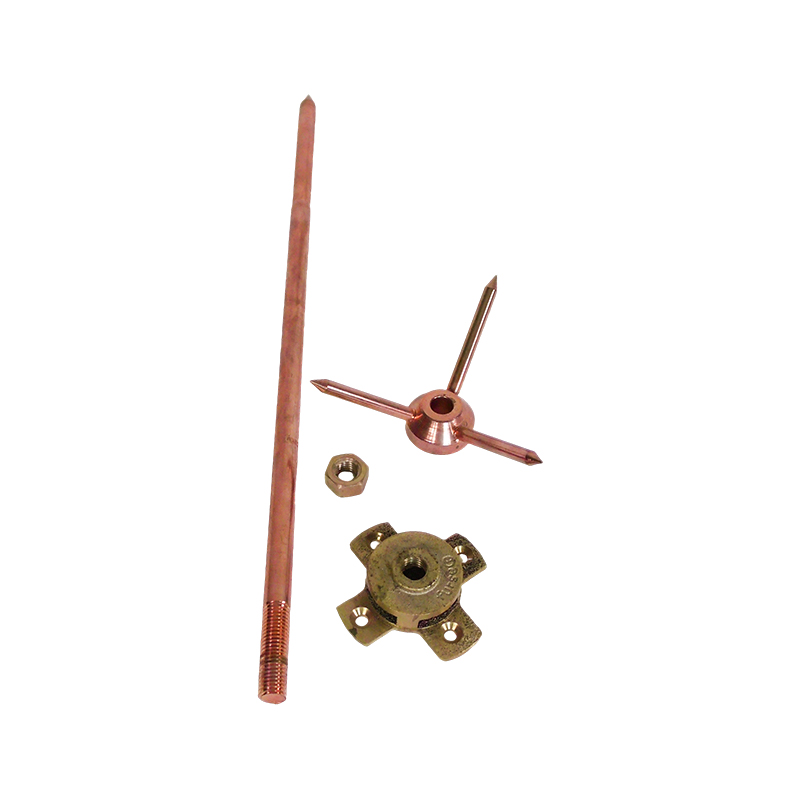 Pure Copper Lightning Rod for Long-Term Outdoor ProtectionPure copper construction offers high conductivity and corrosion resistance for lightning protection on masts, base stations and industrial installations where maintenance-free service life matters.View Product →
option that suits harsh outdoor conditions where long service life matters more than a wide protection angle.
Whatever the terminal, the protection radius, the height above the protected volume and the number of down conductors should be worked out together rather than chosen piece by piece.
The Half of the System Nobody Photographs
The flash is the photogenic part, but the current still has to leave the structure and spread into the soil. Everything below the roof decides whether that happens comfortably or destructively. A low-impedance earth electrode, correctly sized conductors and connections that survive heat, corrosion and repeated faults are what keep a strike from finding its own way through wiring, plumbing or concrete reinforcement.
Soil conditions shape the electrode choice. Copper-bonded steel rods are popular because the steel core carries the mechanical strength needed for driving while the copper surface resists corrosion, which suits most permanent installations. A driven
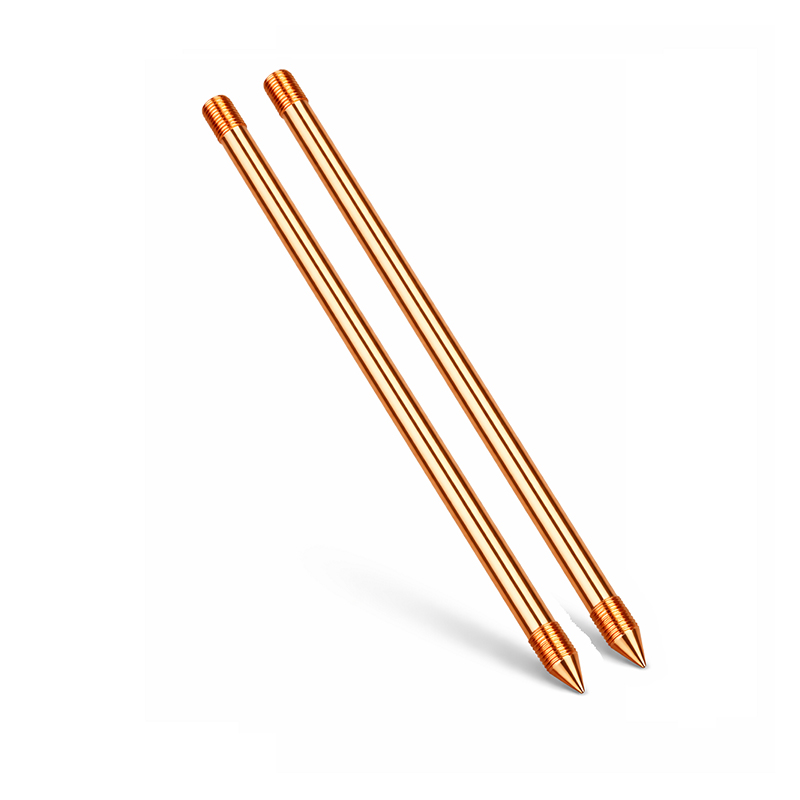 Custom Copper-Clad Steel Grounding Rod for Driven ElectrodesA steel core provides driving strength while the copper layer resists corrosion, making this rod suitable for permanent grounding grids in varied soil conditions.View Product →
is a familiar sight on our customers' sites for exactly that reason, and it pairs well with tape or stranded conductors forming the buried grid.
Connections deserve equal attention. Bolted joints loosen, oxidise and heat up under fault current, while an exothermic weld produces a molecular bond with no contact resistance to drift over the years. The process is simple once you have done a few: the mould is clamped in place, the powder is ignited, and a few seconds later the conductors are permanently joined. It is worth keeping a stock of
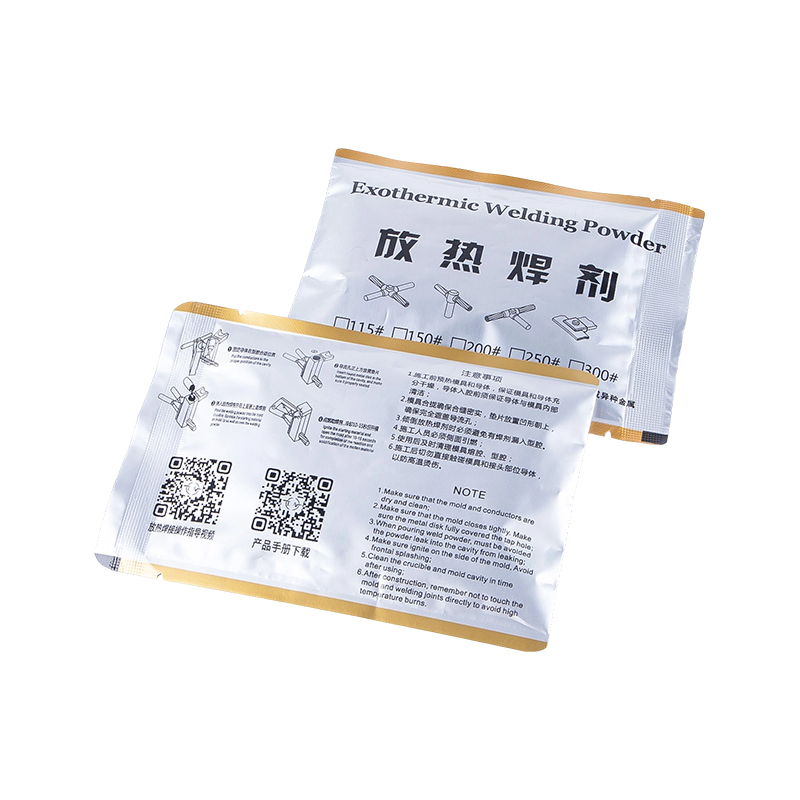 Exothermic Welding Powder for Permanent Conductor JointsSingle-weld and bulk powder options create strong, highly conductive connections for grounding and lightning protection, with mould-matched doses and no external power required.View Product →
on site together with moulds matched to the joint configuration, because the connection geometry has to be known before the crew goes up the tower.
Finally, build in a habit of inspection. Resistance measurements taken every few years reveal a corroded joint long before it fails, and a visual check after a nearby storm costs almost nothing. If you are weighing electrode types, conductor sizes or joint methods for a specific site, the questions our engineers hear most often are collected in our FAQ section and make a reasonable starting point.
Lightning occurs because a thundercloud cannot hold the charge it has separated, and the atmosphere eventually stops resisting. Ice collisions build the field, a stepped leader probes downward, a streamer rises to meet it, and a return stroke does the rest. Knowing that sequence changes the way a protection system is put together. It stops being a collection of parts on a drawing and becomes a continuous path, from the air termination at the top of the structure to the last metre of conductor buried in the soil.
PREV: How Are Lightning Storms Formed? A Clear Guide to the Science and Safety
NEXT: How Electrical Contractors Work: Grounding, Bonding, and Lightning Protection
Contact Us
Your email address will not be published. Required field are marked*
Categories
- Company News(1)
- Industry News(29)
News
-
-
Lightning storms are not a separate kind of weather system; they are thundersto...
Read More -
Electrical contractors rarely arrive on site with a single task. On a grounding...
Read More -
Thunderstorms are one of nature's most dramatic weather events. They can appear...
Read More -
An air terminal by itself does not protect a building. A lightning rod works on...
Read More -
Every lightning bolt is the visible end of a chain reaction that begins well be...
Read More

The company is committed to in-depth research in the field of
grounding and large-scale manufacturing of products. It is a
comprehensive technology enterprise integrating R&D,
manufacturing and technical services. It is a high-quality
supplier for many domestic first-line engineering construction
companies.
- Contact Information
-
- TEL
- +86-575 8930 2616
- +86-130 6788 7328
- Address
- No. 55, Gaoxiang Road, Shengzhou City, Shaoxing City, Zhejiang Province, China
- Grace Wang
- E-mail: [email protected]
- Phone:+86 135 8735 6239
- WhatApp: +86 135 8735 6239
- WeChat: +86 135 8735 6239
- Lucy Xu
- E-mail: [email protected]
- Phone:+86 139 0585 3744
- WhatApp: +86 139 0585 3744
- WeChat: +86 139 0585 3744
- April Zhang
- E-mail: [email protected]
- Phone:+86 139 0585 4994
- WhatApp: +86 139 0585 4994
- WeChat: +86 139 0585 4994

