


 English
 中文简体
Ask any crew that has pulled grounding conductors through a plant retrofit: sol...
Read More

Home · News · Industry News · how much energy is in a lightning bolt: Practical Applications, Selection, Performance
Industry News
how much energy is in a lightning bolt: Practical Applications, Selection, Performance
2026-10-27Content
We field the same question from customers almost every thunderstorm season: how much energy is in a lightning bolt? The short answer is that a typical cloud-to-ground strike releases about 500 megajoules of electrical energy. That equates to roughly 139 kilowatt-hours, or enough to power an average home for nearly five days.
From years of designing grounding systems, we know the answer is not just a number. It is a reminder of why careful engineering matters. A lightning flash delivers its energy in tens of milliseconds, producing temperatures hotter than the surface of the sun. That concentrated burst tests everything it touches, from rooftop air terminals to buried grounding conductors.
Understanding the Raw Power of a Lightning Bolt
Lightning begins as static charges separate inside a thunderstorm. When a stepped leader reaches toward the ground and connects with an upward streamer, a return stroke races upward at close to the speed of light. The visible flash is the return stroke, and it carries the main energy we associate with a lightning bolt.
For a typical negative cloud-to-ground flash, engineers use these approximate figures:
- A charge transfer of roughly 5 coulombs.
- A potential difference of about 100 million volts between cloud and ground.
- A peak current that often exceeds 30,000 amperes.
- A channel temperature near 30,000 degrees Celsius, about five times hotter than the sun’s surface.
The product of charge and potential difference gives the electric potential energy. Since a typical flash moves around 5 coulombs across a potential difference of about 100 million volts, the energy lands in the neighbourhood of 500 megajoules. Some flashes are larger, some smaller, but 500 megajoules serves as the standard benchmark.
To grasp why that energy matters, picture a one-tonne vehicle moving at highway speed. Its kinetic energy is about 0.5 megajoules. A single lightning bolt therefore carries the combined kinetic energy of a thousand such vehicles, focused into a channel no wider than a finger.
Putting Lightning Energy into Familiar Numbers
Megajoules are not an everyday unit for most people. Converting the energy of a typical lightning bolt into other units makes the scale easier to carry around.
| Measurement | Equivalent Value |
|---|---|
| Joules | 500,000,000 J |
| Kilowatt-hours | ~139 kWh |
| TNT equivalent | ~0.12 metric tons |
| Average home usage at 30 kWh/day | ~4.6 days |
In practical terms, 139 kWh is more than twice the energy stored in a modern 60 kWh electric vehicle battery. It is also enough to run a central air-conditioning system for two full summer days. Around 120 kilograms of TNT would release a similar amount of energy, although lightning spreads that energy over a slightly longer time.
These comparisons turn an abstract figure into something people can visualise. They also explain why a structure without proper grounding is at such serious risk.
Why 500 Megajoules Is a Grounding Problem
The energy in a lightning bolt has to reach a location where it can be absorbed safely. A direct strike on a house or industrial facility will immediately look for the lowest-impedance route to ground. If the building lacks a deliberate grounding system, that route might be through metal plumbing, electrical wiring, data cables, or a person standing near a window.
A grounding system intercepts that current and spreads it into the earth before it can create dangerous voltage differences. Every component in that path matters: the air terminal, the down conductor, the connections, and the electrodes buried in the soil. A weak point in any part of the network can turn a survivable strike into a fire or electrocution hazard.
The ground system does not have to absorb the 500 megajoules like a battery. Instead, it gives the current a low-impedance pathway that allows the charge to dissipate through a large volume of soil. The larger the electrode array and the lower the resistance to earth, the smaller the voltage jump between protected equipment and the surrounding ground.
Building a Grounding System That Can Handle a Lightning Strike
Designing a grounding system for lightning protection starts with the buried electrode. Copper-clad steel ground rods are a common choice because they offer the conductivity of copper with the mechanical strength of steel. They are less expensive than solid copper and perform well in most soil conditions.
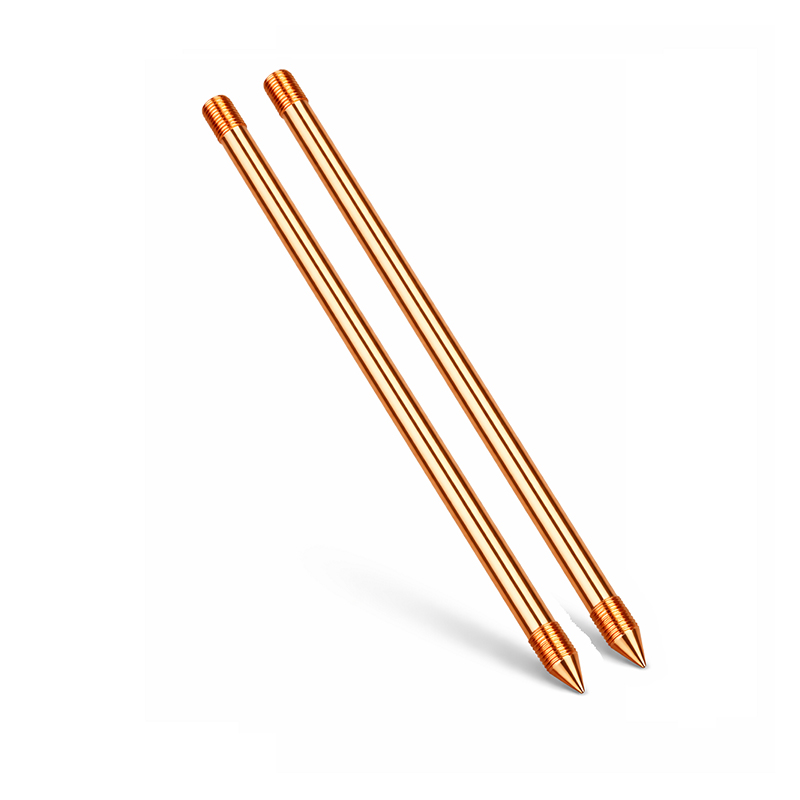 Copper-Clad Steel Ground Rod for Reliable EarthingThis ground rod combines copper conductivity with steel strength, making it a cost-effective electrode choice for lightning protection grounding systems.View Product →
Once the electrode is in place, the conductors that connect it must create a permanent, low-resistance joint. Mechanical clamps can loosen with thermal cycling and corrode over time. Exothermic welding, in contrast, fuses the conductors into a single piece of metal. A cable-to-cable weld performed with the right exothermic mold and powder forms a joint with lower resistance than the cable itself, which is exactly what a lightning surge needs.
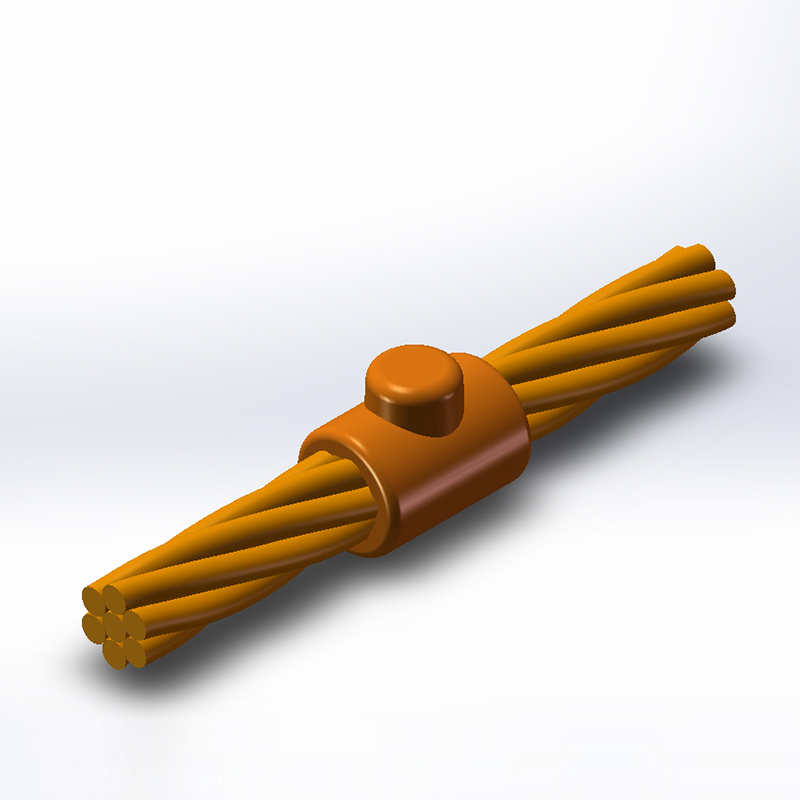 Standard Cable-to-Cable Exothermic Welding MoldThis graphite mold creates permanent, low-resistance welded joints between cables, outperforming mechanical clamps that can loosen and corrode over time.View Product →
For a typical grounding grid, conductors are buried in a ring or grid pattern around the structure. Multiple rods are bonded together, and equipment cases, surge protectors, and utility lines are tied back to the same reference plane. With a robust electrode system and welded connections, the flash can spread into the soil without sending destructive currents into building systems.
Ground resistance is the key performance metric. National standards often recommend a resistance-to-earth of 10 ohms or less, with some critical facilities requiring even lower values. The actual resistance depends on soil resistivity, electrode size, moisture, and temperature. An experienced engineer can measure these values and design a layout that meets the site’s needs.
The Air Terminal and the Path to Earth
Above ground, the air terminal provides the intercept point for a lightning strike. It does not attract lightning in a meaningful way; it simply gives the strike a preferred attachment point so that the current enters the system in a controlled location. A pure copper air terminal is a proven option because of its high conductivity and resistance to atmospheric corrosion.
 Pure Copper Lightning Rod Air TerminalThis pure copper rod provides a durable, corrosion-resistant attachment point for lightning strikes, suitable for critical facilities like substations and aviation hubs.View Product →
From the air terminal, a down conductor carries the current to the grounding electrode. The conductor must be securely bonded to the terminal, the structural frame where necessary, and the ground electrode. In larger installations, several down conductors provide parallel paths, reducing current density and the chance of side flashes.
Many modern protection schemes also include surge protective devices on incoming power and data lines. These devices clamp transient overvoltages and prevent them from travelling through building wiring. The grounding system still needs to absorb the main strike, but surge protectors handle the portion that would otherwise enter equipment.
We often describe lightning protection as a complete path: air terminal, down conductor, connections, and ground electrodes. Each component affects how much of the 500 megajoules reaches the earth safely.
Maintenance and Professional Design
Even the best grounding system needs attention. Soil can change over time; rod connections can suffer corrosion; lightning itself can damage the surface of conductors. Periodic inspection should include a visual check of exposed conductors and connections, a measurement of ground resistance, and a review of the air terminal’s condition.
For anyone responsible for a building, substation, or industrial site, the practical guideline is simple: if the system has not been tested in several years, or if it was installed without a proper design, treat it as suspect. Have an engineer evaluate the layout and make improvements before the next storm season arrives.
In our experience, the most common weakness in existing systems is not the rod itself but the connections. A bolted joint that looks fine from the outside can develop high resistance after years of service. Replacement with a welded connection eliminates that uncertainty. If you are planning a new grounding system or need help with an existing one, contact our engineering team for guidance.
So, how much energy is in a lightning bolt? For a typical strike, about 500 megajoules, or roughly 139 kilowatt-hours. That energy can cause massive damage if it takes an uncontrolled path. Yet with a well-designed air terminal, reliable down conductors, welded connections, and effective ground electrodes, the same energy can be dissipated into the earth without harming the structure. The materials and connections make the difference, and that is where decades of grounding practice still matter most.
If you would like to dig deeper into the physics, we have a practical guide to how lightning rods work that covers the science in plain language.
PREV: How Lightning Is Produced: From Cloud Charge Separation to Ground Strike
NEXT: How Is Lightning Formed? The Complete Science Behind a Lightning Strike
Contact Us
Your email address will not be published. Required field are marked*
Categories
- Company News(1)
- Industry News(29)
News
-
-
Every building, substation and telecom tower quietly depends on metal buried in...
Read More -
Copper-Clad Steel Rod: Definition and Manufacturing Process Analysis What is a C...
Read More -
Exothermic welding is a process that fuses two metal conductors into a single m...
Read More -
Every solar power system faces a real electrical threat from lightning. Whether...
Read More -
Lightning arrives without warning, yet its effects are rarely random. A single ...
Read More

The company is committed to in-depth research in the field of
grounding and large-scale manufacturing of products. It is a
comprehensive technology enterprise integrating R&D,
manufacturing and technical services. It is a high-quality
supplier for many domestic first-line engineering construction
companies.
- Contact Information
-
- TEL
- +86-575 8930 2616
- +86-130 6788 7328
- Address
- No. 55, Gaoxiang Road, Shengzhou City, Shaoxing City, Zhejiang Province, China
- Grace Wang
- E-mail: [email protected]
- Phone:+86 135 8735 6239
- WhatApp: +86 135 8735 6239
- WeChat: +86 135 8735 6239
- Lucy Xu
- E-mail: [email protected]
- Phone:+86 139 0585 3744
- WhatApp: +86 139 0585 3744
- WeChat: +86 139 0585 3744
- April Zhang
- E-mail: [email protected]
- Phone:+86 139 0585 4994
- WhatApp: +86 139 0585 4994
- WeChat: +86 139 0585 4994

